
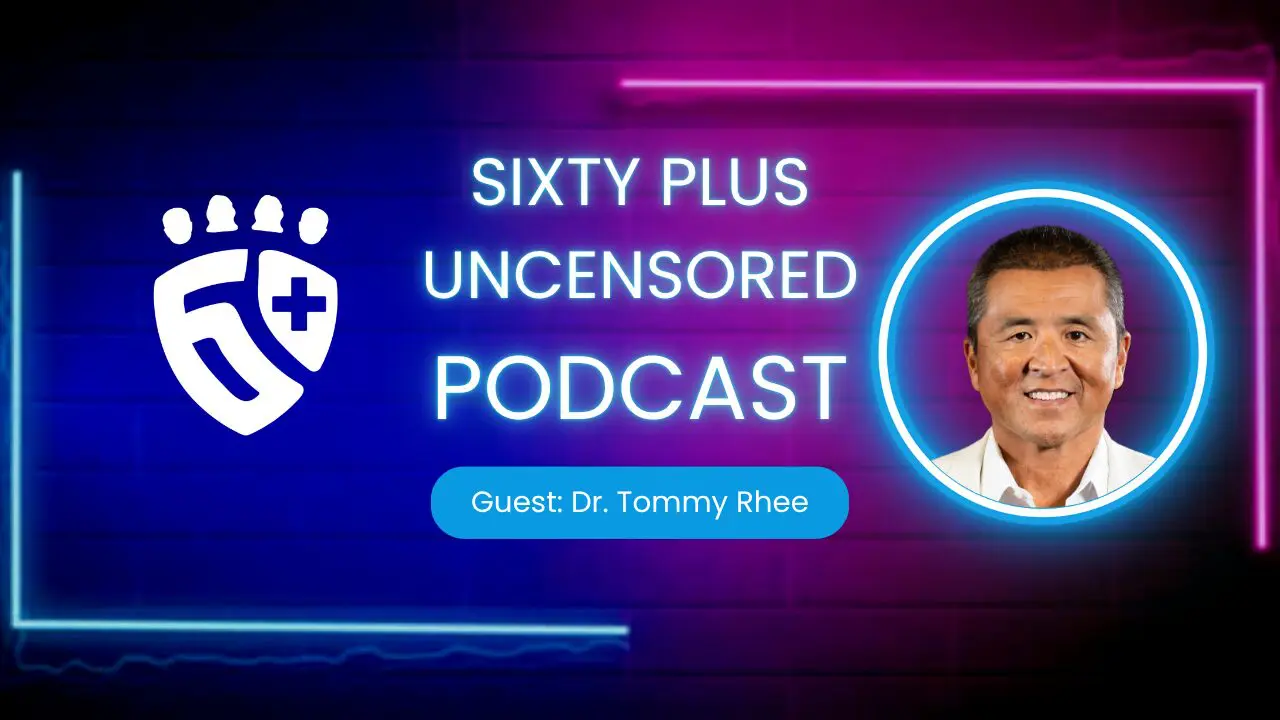
In this episode of Sixty Plus Uncensored, host Seb Frey talks with Dr. Tommy Rhee, a sports chiropractor whose career has taken him from the back seat of a Navy anti-submarine aircraft to the sidelines of UCLA athletics, WWE, and the Tampa Bay Buccaneers. Along the way, Dr. Rhee became fascinated with how elite athletes recover from injury, a question that eventually led him into the world of regenerative medicine, stem cell science, and the development of his own topical product line. Together, Seb and Dr. Rhee talk about what stem cells and peptides actually are, why the field of stem cell therapy remains largely unregulated, and what that means for anyone considering it, particularly for something as common among older adults as arthritis. Their conversation offers an honest, careful look at where regenerative medicine stands today.
Before diving in, it’s worth noting upfront that much of this conversation covers areas of medicine that are genuinely still experimental, not yet approved or regulated by the FDA as standard treatments, and evolving quickly. Dr. Rhee is candid about this himself throughout the conversation. Readers considering any of the therapies discussed here, whether stem cell injections or topical regenerative products, should treat this as a starting point for further research and a conversation with their own physician, not as medical guidance.
From Sonar Operator to Sports Chiropractor
Dr. Rhee’s path started in the Navy, where he served as a sensor operator on an S-3 Viking, a role focused on anti-submarine warfare during the later years of the Cold War. Flying ahead of a carrier battle group, his job involved tracking acoustic signals from sonar buoys to identify potential submarine threats, along with surface search work using radar to help identify unknown ships and aircraft. He describes the experience as formative, instilling the kind of disciplined preparation that shaped how he approached everything that came afterward, including a somewhat wild younger version of himself that the military helped straighten out.
After leaving the Navy, Dr. Rhee pursued a career combining his father’s background in medicine with his own love of sports, eventually training as a sports chiropractor rather than pursuing a more invasive medical path. His first major professional opportunity came at UCLA, where he worked across a range of sports, including track and field, football, basketball, and soccer. He found track and field especially instructive, since each athlete’s success rested entirely on their own individual performance rather than a team effort, which meant his job was to get each athlete into peak physical readiness for a single, high-stakes event, with real, visible feedback on whether his approach was working.
From UCLA, his career moved into professional sports, including a stint with WWE and later work with the Tampa Bay Buccaneers, following a track that repeatedly exposed him to the recovery methods used by elite athletes at the highest level.
Life on the Road With WWE
Dr. Rhee offers a candid look inside professional wrestling, clarifying a common public question: the physical toll is entirely real, even though the storylines and outcomes are scripted in advance. Wrestlers train for years to learn choreographed sequences and their corresponding counter-moves, working with opponents almost like dance partners to create convincing, high-impact performances. But the physical trauma from repeated falls, throws, and impacts accumulates just as it would from any high-contact sport, compounded by a schedule that, unlike most professional sports, has no true off-season. Wrestlers often perform multiple times a week, year-round, as independent contractors responsible for their own travel and, crucially, without a pension or long-term financial safety net once their bodies can no longer keep up.
Dr. Rhee found the travel demands of working with WWE unsustainable for his own practice and eventually stepped away, but the experience deepened his understanding of how physically demanding careers push athletes toward pain management strategies that can, in some cases, lead down a difficult path toward substance dependence, as performers try to keep working through injuries their bodies haven’t had time to properly heal.
How Aging Changes Recovery
Seb asks how the difference between a wrestler two years into their career and one twenty years in shows up physically. Dr. Rhee, now 58 himself, explains that recovery capacity is closely tied to the body’s declining regenerative signaling as we age. Younger tissue responds to injury with strong signals that prompt cells to rebuild ligaments, tendons, and cartilage. As the body ages, those signals weaken, meaning the same type of injury takes measurably longer to heal. He notes an interesting irony: younger athletes often skip the careful warm-up and recovery habits that older athletes have learned to rely on, even though those same habits would likely extend a younger athlete’s career considerably if adopted early.
The slower recovery Dr. Rhee describes is one reason maintaining strength and mobility becomes increasingly important with age, and The Best Low-Impact Exercises for Adults Over 60 offers practical ways to stay active while being gentler on the body.
What Regenerative Medicine Actually Means
Asked to define regenerative medicine broadly, Dr. Rhee describes it as any approach aimed at speeding up the body’s natural tissue-repair process, whether through equipment, nutrition, or more advanced interventions like stem cell-derived therapies. His particular interest lies in what he calls “cell-free” signaling molecules, substances secreted by stem cells that carry instructions to surrounding tissue without introducing a living, dividing cell into the body.
He explains that tissues like cartilage and tendons can regenerate, but the biological signal that tells the body to do so weakens with age, similar to the decline seen with hormones like testosterone. Introducing a fresh version of that signal, in his account, can help “wake up” dormant repair processes in existing tissue. He connects this to the biology of telomeres, the protective caps at the ends of chromosomes that shorten with repeated cell division; once a cell’s telomeres are too short, the cell enters a dormant state called senescence and stops dividing altogether. Dr. Rhee describes certain molecules secreted by stem cells as capable of lengthening telomeres and helping dormant cells resume normal function, though it’s worth noting that telomere biology and its practical therapeutic applications remain an active and still-developing area of scientific research, and claims in this space should be weighed carefully against peer-reviewed evidence.
Peptides and Stem Cells, Explained Simply
Dr. Rhee describes peptides broadly as chains of proteins that act as biological “on” or “off” switches for specific processes. He points to GLP-1, familiar to many now as the basis for popular weight management medications, as an example of a peptide that suppresses appetite, and BPC-157, a peptide he describes as promoting the growth of new blood vessels in poorly vascularized tissue like tendons and cartilage, theoretically improving nutrient delivery to support healing. As with several other claims in this conversation, the specific mechanisms and safety profile of peptides like BPC-157 remain subjects of ongoing research and regulatory scrutiny, and their use outside of approved medical contexts carries real uncertainty.
On stem cells themselves, Dr. Rhee walks through the basic categories: embryonic stem cells, which are “totipotent” and theoretically capable of becoming any tissue type in the body; and various adult stem cells, which are more limited in what they can become. He’s direct in flagging embryonic stem cells as ethically fraught, given their origin, and biologically risky, since introducing a living cell with its own full genetic code into a patient’s body carries a real risk of the cell developing into unpredictable, potentially tumor-forming tissue, since there’s no guarantee it will integrate correctly with the recipient’s own genetic material.
This is part of why Dr. Rhee’s own work focuses specifically on extracellular vesicles, sometimes called EVs, which are the signaling molecules stem cells secrete rather than the stem cells themselves. He reasons that removing the living cell and its nucleus from the equation removes the associated risk of uncontrolled cell growth, while, in his account, retaining much of the beneficial signaling effect.
Where Stem Cells for Therapy Actually Come From
Asked where clinical stem cell therapies typically source their material, Dr. Rhee describes two primary routes: a patient’s own tissue, drawn from fat or bone marrow, or donated tissue from umbilical cords, specifically the gelatinous Wharton’s jelly surrounding the cord, collected with consent during scheduled C-section deliveries after screening donors for disease history. He notes that a patient’s own tissue, while convenient, carries the same age-related signaling limitations as the tissue being treated. In contrast, donor tissue from a newborn’s umbilical cord is, in his view, more biologically active.
He’s candid that this entire space currently sits outside standard FDA drug regulation, classified instead as experimental. This lack of regulatory oversight, he explains, has created real quality control problems in the broader industry. With rising demand for stem cell products outstripping the supply of properly screened donor tissue, some labs have reportedly cut corners, and the FDA has intervened to shut down facilities using improperly sourced or mislabeled material. Patients receiving these therapies, in Dr. Rhee’s account, are often relying entirely on trust in the clinic and lab involved, since verification of what’s actually in a given vial is not something most patients are equipped to do themselves. Given this, anyone considering stem cell injections should ask detailed questions about tissue sourcing, request documentation, and understand that the field remains unregulated as a medical treatment, rather than a proven, standardized therapy.
The Cost and Risk of Injectable Stem Cell Therapy
Dr. Rhee places typical costs for stem cell injections at roughly five to fifteen thousand dollars per injection site, a cost generally not covered by insurance given the treatment’s experimental classification. Beyond cost, he flags real clinical risks associated with any invasive injection, including infection if the injection site isn’t properly prepared, along with the general uncertainty inherent in an unregulated treatment landscape. He’s clear that outcomes vary considerably and that there’s no guaranteed success rate, given the lack of standardized regulation across clinics and labs.
Experimental treatments can introduce significant out-of-pocket costs, making it especially important to understand your broader healthcare coverage; Medicare Explained: A Quick Guide for 2026 (Parts A, B, C, D and Everything in Between) provides a useful starting point for navigating coverage after 65.
A Non-Invasive Alternative: Topical Delivery
Motivated in part by watching athletes lose valuable competitive time to the recovery period required after an injection, Dr. Rhee began developing a topical alternative. His reasoning drew on an observation from his own training: that stem cell injections don’t actually need to be placed directly into damaged tissue to be effective; approximate placement near an injury site can still produce results, apparently because the signaling molecules involved can “home in” on damaged tissue based on distress signals the body itself sends out.
If that’s true at a short distance inside the body, Dr. Rhee reasoned, the same signaling molecules might be able to travel from the skin’s surface down to deeper tissue, provided they could get through the skin’s outer layers. His solution uses dimethyl sulfoxide, or DMSO, a solvent that has been used in topical applications since the 1950s and is recognized by the FDA specifically as a drug delivery vehicle capable of carrying molecules through the skin. Combined with EVs derived from stem cells rather than living stem cells themselves, this became the basis for his topical product, which he tested initially with his own athlete patients during competitive seasons, when they were unable to take time off for an injection’s recovery period.
It’s worth noting that, like the broader stem cell field, this topical product exists outside standard FDA drug approval as well, and Dr. Rhee is upfront that it isn’t regulated as a proven treatment.
Not the Same as Over-the-Counter Pain Creams
Dr. Rhee draws a clear distinction between his product and common over-the-counter topical treatments like Ben Gay, Icy Hot, or Biofreeze. Those products, he explains, work by creating a competing sensory signal, cooling or warming, that distracts from pain without addressing its underlying cause. He argues that masking pain this way can actually be counterproductive, since pain often signals an underlying biomechanical problem, like uneven joint movement wearing down cartilage unevenly, that will continue to worsen if left unaddressed simply because the discomfort has been dulled.
A Second-Generation, Plant-Based Product in Development
Dr. Rhee describes his original topical product as human tissue-derived and currently available only through clinicians, at a retail cost he places in the hundreds of dollars. He’s now developing a second-generation version sourced from plant-derived compounds that he says mimic similar signaling molecules found in human-derived EVs, at a significantly lower projected cost, and without the DMSO carrier used in the earlier formulation. Because this next version would fall under FDA over-the-counter regulation rather than the unregulated experimental category, he expects it to eventually be available directly to consumers rather than exclusively through medical professionals, pending completion of testing, with a projected availability window he estimated as sometime around November of this year, a timeline that of course depends on the outcome of ongoing testing and regulatory review.
He’s direct that the efficacy comparison between plant-derived and human tissue-derived versions is still something the field is working out, framing the appeal of the plant-based version primarily around consistency, cost, and accessibility rather than claiming superior effectiveness at this stage.
Application to Arthritis and Spinal Issues
Given the show’s audience, Seb asks specifically about arthritis, a condition common among older adults. Dr. Rhee describes arthritis as involving both cartilage breakdown and inflammation, and frames his product’s intended benefit as addressing both through the signaling mechanisms discussed earlier. He also addresses spinal issues, distinguishing between the joint and cartilage components of the spine, which he believes his approach could meaningfully help, and actual nerve tissue regeneration, which he describes as a slower, still-developing area of research involving specialized support cells for nerves, with promising but not yet conclusive results.
Given that arthritis and spinal conditions are common, serious concerns for many older adults, and that the therapies discussed here remain experimental and unregulated, anyone dealing with these conditions is best served by discussing treatment options, including any interest in regenerative or stem cell-adjacent therapies, directly with a rheumatologist, orthopedist, or their primary physician before pursuing them.
Because joint and spinal problems can affect everyday movement and independence, Easy Home Workouts to Improve Balance and Flexibility offers accessible ways to support mobility alongside guidance from your healthcare provider.
An Unusual Detour Through Southeast Asia
Partway through the conversation, Seb and Dr. Rhee discover an unexpected shared connection: Dr. Rhee was born in Johor Bahru, Malaysia, just across the causeway from Singapore, and Seb spent a year living in Malaysia himself, later returning with his family for a visit. Dr. Rhee explains that his return to Tampa, Florida, after roughly 25 years living on the West Coast wasn’t purely professional. Having grown up in Malaysia’s tropical humidity, he found that his body never fully adjusted to Southern California’s dry climate, and he repeatedly noticed feeling physically better whenever he returned to Tampa’s more humid, subtropical conditions, which reminded him of home. It’s a small but telling detail in a conversation otherwise focused heavily on biology and technology: even amid all the discussion of cellular signaling and regenerative science, Dr. Rhee’s own sense of physical well-being turned out to be shaped by something as simple as climate and the environment he was raised in.
The Promise and Reality of Regenerative Medicine
Dr. Tommy Rhee’s path from Navy sonar operator to sports chiropractor to developer of a regenerative topical product reflects a career built around watching how elite athletes recover and asking why the same tools weren’t more broadly accessible to everyday people. His account of stem cell science, from telomeres to extracellular vesicles to transdermal delivery, offers a genuinely interesting window into a fast-moving corner of medicine. At the same time, it’s a field that remains largely unregulated, expensive, and still working out basic questions of sourcing, safety, and consistent efficacy. For anyone intrigued by what regenerative medicine might offer for arthritis, joint pain, or general recovery, the most responsible next step isn’t to sign up for the first available injection or topical product, but to bring these questions to a trusted physician who can help separate genuinely promising science from treatments that are, for now, still very much in progress.