

Seb Frey is a REALTOR® and founder of Team Sixty Plus, a curated network connecting older adults and their families with trusted professionals across California. With decades of experience helping homeowners 60+ navigate major life transitions—like downsizing, aging in place, or passing on a legacy—Seb brings deep market knowledge, a compassionate approach, and a commitment to simplifying complex decisions. When he’s not advising clients, he’s sharing expert insights on real estate, retirement strategies, and quality-of-life resources for the 60+ community.
I’ve spent more than two decades working with older homeowners and their families, and if there’s one thing I’ve learned, it’s that the biggest decisions of later life rarely happen in isolation. That is why age-friendly health systems, built around the 4Ms, matter so much to families. Where you live, how you receive care, and whether you can keep doing the things that give your life meaning are all tangled up together. That’s why I pay close attention to what’s happening in health care for older adults, and why I want to tell you about a movement that deserves far more attention than it gets: Age-Friendly Health Systems and the 4Ms Framework, especially as it’s now being rolled out in home health care.
If you’re an older adult receiving skilled nursing or therapy at home, or if you’re the adult son or daughter coordinating care for a parent, this framework gives you a practical way to evaluate the care being delivered and to advocate for better. Let me walk you through what it is, why it exists, and how to put it to work for your family.
Why Age-Friendly Health Systems Became a Movement
America is getting older, fast. The Census Bureau projects that the population aged 65 and up will nearly double between 2012 and 2050, growing from about 43 million to roughly 84 million people. As of 2024, more than 54 million Americans are 65 or older, which works out to about one in six of us. The older population is also becoming more diverse, with the share of older adults identifying as something other than White growing from 15 percent to 23 percent between 2010 and 2020.
Here’s the uncomfortable truth behind those numbers: our health care system wasn’t built for this. Care gets more complex as we age, and health systems have struggled to keep up. Older adults experience a disproportionate share of harm while receiving medical care, and older adults from historically marginalized communities fare even worse.
In 2017, The John A. Hartford Foundation and the Institute for Healthcare Improvement, working with the American Hospital Association and the Catholic Health Association of the United States, decided to tackle this problem directly. They set out to build a social movement with a simple but ambitious goal: make all care for older adults age-friendly care. By their definition, age-friendly care follows evidence-based practices, causes no harm, and aligns with what actually matters to the older adult and their family.
That movement has grown to include more than 4,900 hospitals, medical practices, clinics, nursing homes, and home health care organizations. And in January 2025, IHI published a dedicated guide bringing this framework into home health care, which is where I think it gets really interesting for the families I work with every day.
Guide Your Aging Parents Through Their Later Years
Download our plain-spoken guide to helping your aging parents manage care, finances, the long-time family home, and estate.
Get the Guide!What Are the 4Ms? The Framework Explained
At the heart of the Age-Friendly Health Systems initiative is something called the 4Ms Framework. The four Ms are What Matters, Medication, Mentation, and Mobility. Together, they take the overwhelming complexity of caring for an older adult and organize it around the issues that should drive every care decision.
What I appreciate most about the 4Ms is the philosophy behind them. This isn’t a program that gets layered on top of existing care, and it isn’t a checklist that treats older adults as a bundle of diagnoses. The framework organizes care around a person’s wellness and strengths rather than solely around disease. It applies to every older adult regardless of their conditions, their cultural or religious background, or their income. Let me break down each M.
What Matters
This is the foundation everything else rests on. Care teams are expected to ask each older adult about their specific health outcome goals and care preferences, document the answers, and then actually align the care plan with them.
Health outcome goals aren’t medical jargon. They’re things like babysitting a grandchild, walking with friends in the morning, volunteering at church, or staying in the home you’ve lived in for forty years. Care preferences cover what you’re willing and able to do or receive, from medications to testing to self-management tasks. And while advance care planning matters, What Matters conversations aren’t just about end of life. They apply across the entire span of later life.
In my world, this maps almost perfectly onto the conversations I have with clients about housing. When I sit down with a longtime homeowner thinking about downsizing, the first question is never about square footage or price. It’s about what they want their life to look like. Health care is finally catching up to that same person-first logic.
Medication
The second M asks a deceptively simple question: if medication is necessary, is it age-friendly medication that doesn’t interfere with What Matters, with thinking clearly, or with moving safely?
Home health teams practicing the 4Ms review each older adult for high-risk medications, and the list is specific. It includes benzodiazepines, opioids, highly anticholinergic drugs like diphenhydramine (the active ingredient in many over-the-counter sleep aids), prescription and over-the-counter sedatives and sleep medications, muscle relaxants, tricyclic antidepressants, mood stabilizers, and antipsychotics. These medications, alone or in combination, can increase the risk of confusion, delirium, unsteadiness, and falls in older adults.
Where appropriate, the framework calls for deprescribing, which means reducing doses or discontinuing medications entirely through a careful, person-centered process involving the older adult, their prescriber, and often a pharmacist. If you’ve ever watched a parent’s pill organizer grow year after year without anyone stepping back to ask whether every medication still earns its place, you understand why this M exists.
Mentation
Mentation covers the mind, and in the home health context it breaks into three areas: dementia, depression, and delirium. Age-friendly home health teams screen for all three at the start of care, when care resumes after a hospital stay, and whenever there’s a significant change in condition.
Delirium deserves special mention because so many families have never heard the word. Delirium is a sudden change in mental status, and unlike dementia, it usually has an underlying medical cause and is preventable and treatable in most cases. It can and often does occur on top of existing dementia, which is why any sudden change in how a loved one thinks or behaves should be treated as delirium until proven otherwise. Common culprits include dehydration, constipation, infection, and medications.
Depression screening matters too, and the framework pushes teams to go beyond the screening itself. Care teams are expected to identify and manage the factors contributing to depression, including vision and hearing loss, social isolation, bereavement, and the losses that come with aging, like the end of a career or a change in social roles. I see this constantly in my work with older sellers. A move triggered by loss is a completely different emotional experience than a move toward something, and the people supporting an older adult need to understand the difference.
Medicare Made Simple
Medicare can be complicated – so let us break it down for you! Get our quick and easy guide, Medicare Made Simple!
Get the Guide!Mobility
The fourth M is about making sure every older adult moves safely every day in order to maintain function and do What Matters. Notice what that says and what it doesn’t say. The focus is on promoting early, frequent, and safe movement, not just preventing falls. Asking about falls is important, but it isn’t sufficient.
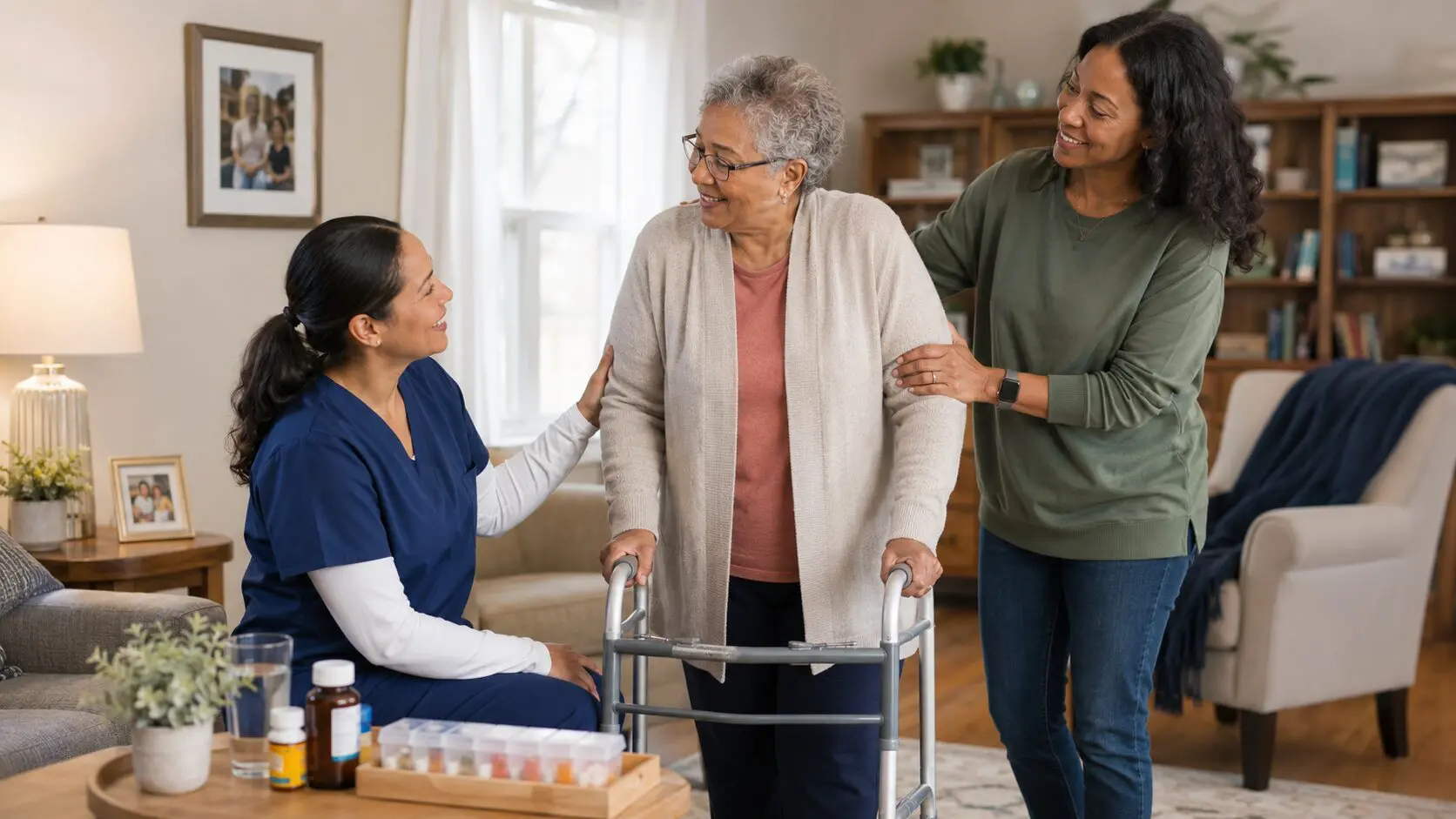
In practice, home health teams screen for mobility limitations using evidence-based tools like the Timed Up & Go test, help each older adult set a daily mobility goal that connects to their personal priorities, refer to physical therapy when needed, and address environmental hazards in the home. That last piece is where health care and housing overlap directly, and it’s something I’ll come back to.
Why Home Health Care Is the New Frontier for the 4Ms
The January 2025 IHI guide defines home health care specifically: skilled nursing or rehabilitation services provided by licensed professionals like nurses and physical therapists, ordered by a clinician, and delivered in the home. This is a huge and growing corner of American health care. Home health services reach roughly 15 million patients each year, and about 70 percent of them are 65 or older. Home health providers collectively travel billions of miles to make hundreds of millions of visits to older adults who overwhelmingly prefer to receive care in the comfort of their own homes.
That preference is something I hear from clients constantly, and the research backs it up. Most older adults want to age in place. Home health care is often what makes that possible after a hospitalization or as chronic conditions progress.
But home health care has a structural challenge that hospitals and nursing homes don’t. In a facility, professional caregivers are present around the clock. At home, different team members come and go at different times: a nurse one day, a physical therapist another, maybe a social worker or pharmacy consultant along the way. Nobody is there continuously. That makes coordination, documentation, and communication absolutely critical. The 4Ms give every member of that rotating team a shared framework, so the physical therapist knows what the nurse learned about What Matters, and everyone is watching for the same warning signs around medication, mentation, and mobility.
The guide is also refreshingly honest about equity. Research cited in the document found that Black and Hispanic older adults are measurably less likely to use high-quality home health agencies than White older adults in the same neighborhoods, and lower-income older adults are less likely to use home health at all. Age-friendly care means closing those gaps, not just improving averages.
Family Guide for Aging in Place
For Families with Older Adults who are looking to help with a Parent with Aging in Place!
Get the GuideWhat the 4Ms Look Like in a Real Home
Abstract frameworks come alive in real stories, and the IHI guide includes two that stuck with me.
In the first, a regional clinical director describes her own mother, a frail 90-year-old, being asked in the hospital what brought her joy and what concerned her most about her health. Her answers went up on a whiteboard in her room. What mattered most to her was avoiding more needle sticks, and the care team honored that wherever possible. When she came home and started physical therapy through home health, the therapist asked the very same questions. Her mother laughed, and then she got it: everyone on her care team was supposed to know what she really wanted. Her therapists built their work around her stated priorities, which were getting stronger and staying home, and the relationship they formed became part of her recovery.
The second story involves a man the guide calls David, referred to home health after a hospitalization with a genuinely complicated picture: uncontrolled diabetes, hypertension, schizophrenia, advanced kidney disease, and depression, living alone and struggling with confusion and low health literacy. The home health team started with What Matters, which for David meant managing his conditions well enough to live independently. From there, the Ms worked together. The team addressed medication adherence with a pre-filled pill box and coordinated psychiatric care, which improved his mental clarity, which in turn supported his mobility and independence at home. The staff reported something worth noting: watching David’s quality of life improve increased their own job satisfaction. Good care feeds everyone.
Questions Families Should Ask a Home Health Agency
Here’s where this becomes practical for you. If you or a parent is starting home health care, the 4Ms give you a ready-made set of questions to ask, and the answers will tell you a lot about the agency.
Ask whether anyone will sit down with your loved one and ask what matters most to them, and where that answer gets documented so every member of the team can see it. Ask how the team reviews medications for high-risk drugs, and whether a pharmacist or the prescribing physician gets involved when something looks concerning. Ask what screenings are done for memory, mood, and sudden confusion at the start of care and after any hospital stay. Ask how mobility is assessed, whether a daily movement goal will be set, and whether someone will evaluate the home itself for hazards.
You can also ask directly whether the organization participates in the Age-Friendly Health Systems movement. IHI formally recognizes organizations that have committed to practicing 4Ms care, and participation signals that an agency has done the work of describing exactly how it assesses, documents, and acts on all four Ms for every older adult.
One more tip from the guide that families can borrow: educate yourself on the signs of delirium and speak up the moment your loved one doesn’t seem like themselves. Family members are often the first to notice a change, and the care team needs to hear about it right away.
Tap Into your Home Equity
Need to raise some cash to pay for home improvements, or anything else? Get our Guide on Creative Ways to Tap Into Home Equity
Get our Guide!Where Housing Fits Into the 4Ms
I’d be leaving out half the story if I didn’t connect this to the work I do every day. Mobility, the fourth M, explicitly includes addressing environmental hazards in the home. A beautifully designed care plan can be undone by a steep staircase, a step-down living room, a bathroom with no grab bars, or a laundry room in the basement.
Sometimes the answer is modification: better lighting, secured rugs, a walk-in shower, a ramp. Sometimes, honestly, the answer is that the house that served a family wonderfully for decades no longer serves the person living in it. That’s not a failure. It’s information, and it deserves the same What Matters conversation the health care team is having. What do you want your daily life to look like, and does your current home make that easier or harder?
When I work with older homeowners and their families through a downsizing or estate transition, we’re really applying the same logic as the 4Ms: start with what matters, understand the practical constraints, protect independence and safety, and make a plan that the whole family can see and support. Health care and housing decisions work best when they’re made together, and the professionals involved, from home health nurses to care managers to elder law attorneys to REALTORS® who specialize in this work, should all be pulling in the same direction.
The Bottom Line
The Age-Friendly Health Systems movement, and its expansion into home health care, represents something families have wanted for a long time: care that starts with the person instead of the diagnosis. The 4Ms Framework of What Matters, Medication, Mentation, and Mobility isn’t complicated, and that’s exactly the point. It takes the sprawling complexity of caring for an older adult and focuses everyone, professionals and family members alike, on the things that most affect safety, independence, and quality of life.
If someone you love is receiving home health care, learn these four Ms and use them. Ask the questions. Expect the screenings. Make sure What Matters is more than a phrase on a form. And if the conversation eventually turns to whether the home itself still fits the life your family member wants to live, know that there are professionals who specialize in exactly that transition and who will start the same way good health care does: by asking what matters to you.
You can learn more about the Age-Friendly Health Systems initiative, including guides for every care setting and a directory of recognized organizations, at ihi.org/AgeFriendly.
