
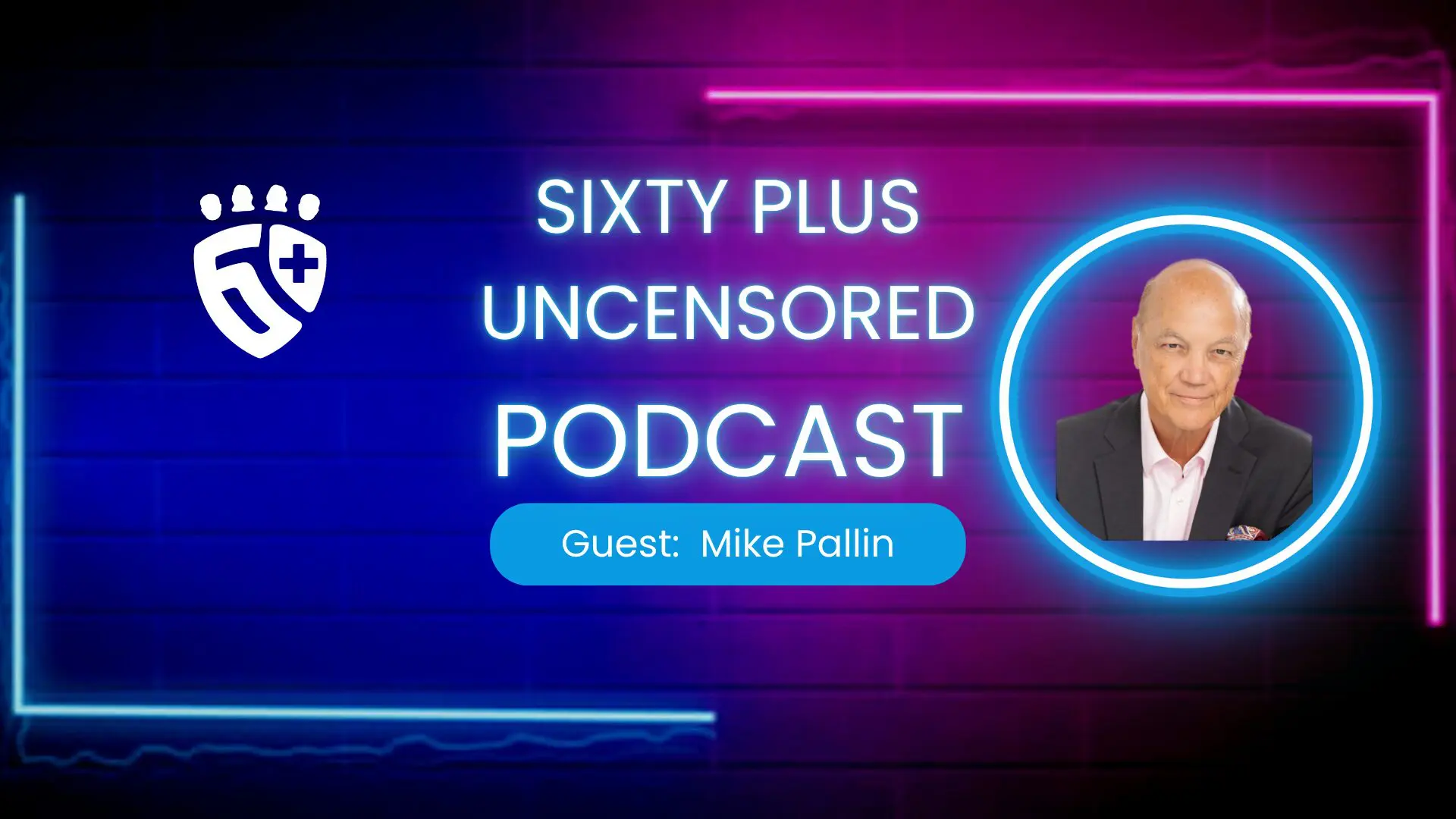
In this first episode of Sixty Plus Uncensored, host Seb Frey sits down with Mike Pallin, a longtime real estate coach, speaker, and the president of Floyd Wickman Companies, one of the most respected training organizations in the real estate industry. Mike has spent decades mentoring thousands of agents, Seb included, and he still shows up to the work with the same intensity he had when he started. Together, they talk about the structured morning and evening rituals that shape Mike’s days, the moment that transformed his career from teaching to coaching, why he thinks people wildly overestimate how much of what they worry about ever actually happens, and what he considers the five senses that matter more than the physical ones as we get older.
What Keeps Him Fired Up
Seb opens by asking Mike where he is in life right now and what’s keeping him energized. Mike’s answer is direct: the business itself, the relationship he shares with his wife, and the life the two of them have deliberately built together. What matters most to him is that the work remains genuinely relevant and that it goes beyond simply earning a living. As he puts it, he and his wife are focused on making a difference, and that sense of purpose is what keeps him engaged.
A Morning Routine Built Like a Ritual
Asked about his daily habits, Mike describes a structured morning practice that he and his wife, Mary, follow together nearly every day, whether they’re at their home in Naples, Florida, or in Minnesota, where Mary grew up. The routine typically takes between 30 and 60 minutes and unfolds in a consistent sequence.
It starts with simple conversation over coffee, catching up on what’s ahead for the day. From there, they listen to a short recording, about seven minutes long, designed to put them in a mindset of abundance and gratitude. Next comes reading, sometimes from the Bible, sometimes from a church bulletin, and at times working through a page of a specific book together, such as one focused on strengthening marriage. After that, they go through a list of people they hold in their thoughts, offering gratitude and well wishes for those who are struggling, grieving, or facing addiction, with particular attention to family, children, and grandchildren. The routine then moves into a period of silence, followed by journaling.
Once that’s complete, they shift into planning the workday, but not with an exhaustive to-do list. Mike explains that he and Mary limit themselves to the five most important tasks for the day, a practice he traces back to a concept from a book on the Rockefeller family’s approach to building the railroads. The idea is simple: a to-do list with 180 items is functionally impossible to complete, and trying to work through it usually means ending the day focused on everything that didn’t get done. Prioritizing five high-value tasks, by contrast, tends to produce far more genuine progress, with time left over for smaller matters.
Mike and Mary follow this same structure seven days a week, without exception, whether they’re together or apart. When they’re apart, they complete the routine separately but keep it consistent, sometimes checking in with each other by phone before the day begins.
Mike’s commitment to beginning each day with a consistent structure reflects the ideas in The Power of Routine: Building Structure in Retirement, which explores how purposeful daily habits can bring focus and meaning to life after 60.
Bookending the Day With Gratitude
Just as deliberately as they start the day, Mike and Mary close it with a matching evening ritual. This end-of-day routine involves reflecting on what happened, identifying the most meaningful accomplishment of the day, and naming what they’re grateful for. Mike describes gratitude as one of the most powerful emotional forces available to a person, right alongside love and hate in terms of its influence. His belief is that starting the day in gratitude and ending it the same way creates a kind of buffer that makes whatever happens in between far more manageable. He compares it to putting a clear beginning and a clear ending on a sentence: when both bookends are solid, the middle tends to take care of itself.
Did He Expect This Life?
Seb asks whether Mike, looking back decades earlier, ever imagined he’d be living this life today. Mike answers with characteristic humor, noting that most people who reach his age have done reckless enough things in their youth that simply being alive and healthy is itself something to be grateful for. Even so, he says he always had a sense, even early on, that he’d be able to build the kind of life he wanted, even if he couldn’t have predicted every detail. Looking back now, he describes the outcome as having exceeded his expectations, and he’s clear that it’s still very much in motion, not something he considers finished or settled.
From Musician to Real Estate Trainer
Seb asks Mike to trace the arc of his career, and Mike takes it back to the beginning: after finishing his time in the Army and completing his college degree, his original goal was to become a famous musician, since he was already a working one. Recognizing just how unlikely fame in music actually is, he eventually moved into sales, cycling through a few different products before landing, almost by accident, in real estate, nudged into the business by his brother-in-law.
His path into coaching came through an unusual route. A real estate franchising company hired him to handle training, and part of that job involved driving guest speakers from city to city for sales rallies, sometimes running six-city tours every couple of months. Through that work, he met most of the prominent speakers on the real estate circuit at the time. Most of them, he says, carried themselves as polished, high-energy performers. But one speaker stood out: a man named Floyd Wickman, who was, in Mike’s words, the same genuine person off stage as he was on it, smart, caring, and focused on actually helping people get results.
Mike became determined to work with Wickman directly, but it took two years and three separate requests before Wickman, who had been running the business as essentially a one-man operation, agreed to bring him on. Mike draws a specific lesson from that experience: if you build the discipline of asking for what you want exactly three times, never more and never less, you’ll usually get it without coming across as pushy. When Wickman finally agreed, roughly 35 to 40 years ago, Mike became the first person other than Wickman himself to teach the Wickman training program, and his early results actually surpassed Wickman’s own. Wickman has since retired comfortably, having entrusted his life’s work and legacy to Mike and Mary.
The Pivot From Teaching to Coaching
Roughly sixteen years ago, in June of 2009, Mike found himself in a room full of program graduates in the middle of the housing market collapse. The agents in front of him looked visibly frightened, uncertain how they could hit their income goals with the real estate market in freefall.
Drawing on a practice already built into the Wickman program, team huddles where members reported their numbers, shared what was working, and worked through obstacles together, Mike offered a proposal: get on a call with him once a week for an hour, report your numbers honestly, and share what’s working and what isn’t, for six months. He told the group he believed this process could help them hit their goals regardless of the surrounding market conditions. Twenty-four agents volunteered.
At the end of those six months, the group had collectively hit 103 percent of their combined goal. Mike describes this as his “eureka moment”, the realization that he had found something genuinely capable of making a difference in people’s outcomes, beyond what classroom training alone could deliver. That format, weekly calls where participants report activity and results, receive real-time feedback, and share ideas using a brainstorming method rooted in the mastermind concept popularized by Napoleon Hill and originally used by Henry Ford, has continued for sixteen years, now supported by a team of five coaches who have worked with thousands of agents.
Mike describes the core function of a coach in simple terms: giving people immediate feedback on their performance and helping them make small course corrections, which tend to produce outsized results over time. For him, there’s no greater satisfaction than helping someone hit a goal, however large or small, because doing so tends to shape not just a better income but a better person, someone equipped to genuinely serve their clients rather than merely survive in the business. That ripple effect, he notes, extends outward from the individual agent to their family, their community, and every business they touch.
Mike’s fulfillment in helping others reach their goals also connects with When Retirement Feels Too Small: How to Reclaim Purpose, Connection, and Joy, which explores how contribution can provide a renewed sense of purpose later in life.
A Second Turning Point, Away From Work
Seb asks whether there have been other major turning points in Mike’s life beyond his professional pivot. Mike shares, without going into extensive detail, that he eventually left an unhappy marriage, later than he probably should have, without any specific plan for what came next. It was during that period that his relationship with the current love of his life, whom he’d actually known for years as a close friend and colleague, shifted into something deeper. He describes the last eleven years with her as the best of his life, and credits both her and the sense of stewardship over Wickman’s legacy as core reasons he remains as engaged in the work today as he ever has been.
He connects this sense of responsibility to other well-known legacies in the personal development and training world, comparing it to how Napoleon Hill’s and Zig Ziglar’s work has continued through dedicated foundations after their deaths. Wickman’s underlying philosophy, built around genuinely caring about what clients care about rather than treating them as transactions, is something Mike feels a real obligation to protect and carry forward.
What People Get Wrong About Aging
Asked what people commonly misunderstand about being in their sixties or older, Mike’s answer centers on mindset rather than appearance. Wrinkles and gray hair, he says, are simply part of the territory; what actually determines someone’s experience of aging is how they think and whether they stay curious. He references a book called Younger Next Year, which he considers nearly as influential to his own outlook as any other book he’s read, for its framework on how to actively care for the body over a longer lifespan. He points to Dick Van Dyke’s hundredth birthday celebration, still dancing and performing, as an example of what’s possible when someone refuses to let age define their capability.
The phrase that genuinely bothers him is “I’m too old for that.” In his view, that kind of language marks the moment someone gives up, and giving up is what actually causes a person to fade, not age itself.
The Surprises of Getting Older
Mike identifies two things that have genuinely surprised him about aging. The first is simply how fast it happens. He recalls being told, shortly after the birth of his first child while teaching a program in Maine, that the child would be asking for the car keys before he knew it, advice that turned out to be exactly right.
The second surprise runs deeper: how rarely the things people worry about actually happen. He describes an exercise Floyd Wickman once had the whole group do, writing down every current worry, including ones from the past. When Mike’s group revisited their lists a year later, of the 82 items on his own list, only one had actually occurred. His conclusion is blunt: worry is largely wasted time.
Ego, Evolution, and What Actually Matters
Seb asks how Mike has evolved, both as a coach and as a person, over the years. Mike is candid that his early motivation for teaching and coaching was rooted in ego, wanting to be seen as smart, to have all the answers, and to receive approval and attention. The shift came when he stopped focusing on his own performance and started focusing on the people he was working with, taking pride in what they accomplished rather than what he demonstrated. He describes that shift as a complete reversal in priorities.
He connects this to a quote attributed to Maya Angelou, that people forget what you did and what you said, but never forget how you made them feel. Seb references the book Ego Is the Enemy, and both agree that high-achieving, high-ego figures tend to succeed in spite of their egos rather than because of them. Mike suggests that real fulfillment tends to come from focusing on helping others get what they want, a sentiment he ties back to a well-known principle from Zig Ziglar.
Staying Physically Active
On the subject of physical health, Mike credits a shift toward a more plant-based diet, influenced by a book on regenerative farming called Kiss the Ground, which examines how conventional agricultural practices deplete soil and, by extension, the nutritional quality of food. He and Mary have been gradually moving away from heavily processed foods as a result.
Physically, his routine varies by season and location. In Florida, that means daily pickleball and swimming laps in the pool; during the summer months, he plays golf three to four times a week, something made possible by working roughly 40 hours a week rather than filling every waking hour with work. He credits his background as a competitive swimmer growing up with helping preserve flexibility in his joints and tendons over time, contrasting that with friends who played higher-impact sports like football and now deal with more physical wear. Alongside physical activity, he and Mary stay mentally engaged by reading extensively, watching documentaries, and exposing themselves regularly to new ideas, a habit that led them to books like Kiss the Ground and The Biology of Belief in the first place.
Mike’s regular swimming, pickleball, and golf demonstrate how movement can remain part of everyday life as we age, while The Best Low-Impact Exercises for Adults Over 60 offers more accessible ways to maintain strength, mobility, and activity.
The Honest Frustrations of Getting Older
In a segment Seb calls “the uncensored truth,” he asks Mike what genuinely annoys him about aging. Mike keeps it light: minor skin growths that require an annual visit to the dermatologist for removal, and the small indignity of a server at a restaurant forgetting who ordered what. Beyond that, he says very little actually irritates him these days, and he credits aging itself with a meaningful increase in patience, particularly noticeable behind the wheel.
Asked what’s improved with age, Mike quotes the late singer Toby Keith: “I’m not as good as I once was, but I’m as good once as I ever was,” leaving the rest to interpretation.
An Unpopular Belief, and the Power of Words
Pressed for an unpopular opinion, Mike circles back to his frustration with people who declare themselves too old for something, pointing to a 90-year-old friend he regularly plays pickleball with as proof of what’s possible. He connects this to a broader belief in the power of language and intention, describing a morning practice of using vision boards to clarify what he and Mary want to manifest in their lives. He references a line from Wallace Wattles’s 1911 book The Science of Getting Rich about a universal “thinking stuff” that responds to clearly imaged thought, and connects it to Earl Nightingale’s well-known idea that people become what they think about. Whether or not a listener shares this specific framework, the underlying practice, being genuinely clear and intentional about what you want rather than leaving it vague, is one Mike credits with shaping much of his life’s direction.
Advice to His Younger Self
Asked what he’d tell himself from ten years ago, Mike’s answer is short: take more chances, and trust that it will work out. He connects this to Steve Jobs’s well-known willingness to cannibalize his own successful products before a competitor could do it for him. Mike applies the same logic to his own business, noting how the company has evolved from in-person classroom training to livestream instruction during COVID to ongoing coaching, and how he’s now reviving Wickman’s original “Sweathogs” program in an updated format for a changed industry. His broader point is that the underlying principles behind lasting success rarely change, but the format and delivery have to evolve continuously to stay relevant.
Five Senses Beyond the Physical
Toward the end of the conversation, Mike offers what may be the most distinctive piece of his philosophy: the idea that while the five physical senses naturally dim with age, five other senses matter even more, and tend to get stronger the more attention a person gives them.
The first is a sense of direction, which he links to having specific, measurable, time-bound goals that come from genuine internal motivation rather than external pressure. The second is a sense of accomplishment, the kind of satisfaction that comes from helping someone else achieve something meaningful, which he illustrates with an example from his own coaching work with Seb, where a simple review of recurring subscription payments saved real money each month. The third is a sense of wonder, which he connects to a book called The Biology of Belief, describing research suggesting that a person’s thoughts can directly influence cellular behavior. The fourth is a sense of belonging, something he believes people tend to unintentionally withdraw from as they age, even though genuine connection with others consistently deepens his own enjoyment of life. The fifth is intuition, described simply as paying attention to hunches and quiet inner signals throughout the day. When someone actively engages all five of these senses, Mike says, life becomes something closer to an ongoing adventure rather than something to merely endure.
His emphasis on direction, accomplishment, wonder, belonging, and intuition also reflects How to Stay Positive and Motivated as You Age, which looks at practical ways to remain engaged with life and maintain a forward-looking perspective.
Looking Ahead
Asked what he’s most looking forward to, Mike mentions an upcoming first trip to Europe with Mary, prompted by their daughter’s wedding in France, which will also include babysitting a new grandchild and traveling through Paris, Rome, and Florence. He also mentions a long-running annual golf tournament with his brother and the relaunch of Wickman’s original training program under a new, updated format. He recently published his first book, Rethink Everything You Know About Selling Real Estate, reflecting the same philosophy of evolving proven principles into new, relevant formats rather than abandoning them.
The Habits Behind a Life Well Lived
What comes through clearly in this conversation is that Mike Pallin’s vitality at this stage of life isn’t accidental. It’s the product of consistent daily structure, a career built around genuinely helping other people succeed rather than chasing personal recognition, and a deliberate refusal to let the phrase “too old” enter his vocabulary. His morning and evening rituals, his weekly coaching calls, and his ongoing curiosity about new ideas all point to the same underlying habit: treating each day, and each decade, as something still being actively built rather than something already finished. For anyone wondering what staying sharp and engaged past sixty actually looks like in practice, Mike’s answer isn’t a single secret. It’s a set of small, repeated choices, made consistently enough that they eventually add up to a life that still feels, in his words, like a great ride that’s still going on.
Links for Further Reading
- The Rockefeller Habits by Verne Harnish
- Think and Grow Rich by Napoleon Hill
- Younger Next Year by Chris Crowley and Henry S. Lodge
- Kiss the Ground by Josh Tickell
- The Science of Getting Rich by Wallace D. Wattles
- Ego is the Enemy by Ryan Holiday
- The Biology of Belief by Bruce H. Lipton
- Rethink Everything You Know About Selling Real Estate by Mike Pallin
- FloydWickman.com
- Floyd Wickman.com Coaching
- Note: A specific service offered by FloydWickman.com.
- URL: https://www.floydwickman.com/r-squared-coaching