

Seb Frey is a REALTOR® and founder of Team Sixty Plus, a curated network connecting older adults and their families with trusted professionals across California. With decades of experience helping homeowners 60+ navigate major life transitions—like downsizing, aging in place, or passing on a legacy—Seb brings deep market knowledge, a compassionate approach, and a commitment to simplifying complex decisions. When he’s not advising clients, he’s sharing expert insights on real estate, retirement strategies, and quality-of-life resources for the 60+ community.
Aging in place sounds dignified. Stay in your own home. Keep your routines. Sleep in the bedroom you actually like. Make coffee in the same kitchen where you’ve already had ten thousand cups and know exactly which cabinet sticks.
Then the house starts pushing back.
That one front step you never noticed suddenly feels taller. Door thresholds develop opinions. The garage entry becomes a daily negotiation. And stairs? Stairs don’t age gracefully with the rest of us.
Residential accessibility isn’t about giving up independence. It’s about defending it—quietly, practically, and without making your home feel like a hospital wing. That’s where HandiRamp earns its reputation.
HandiRamp has been building accessibility solutions since 1958, long before “aging in place” became a marketing phrase. Their residential products focus on one idea that actually works in real life: adjust the environment so people can keep living normally, even as mobility changes.
Aging in Place Starts at the Doorway
Most homes don’t fail accessibility in dramatic ways. They fail in small, persistent ones. A single step at the front door. A raised threshold that catches a walker. A narrow transition that requires concentration every single time.
HandiRamp’s residential accessibility products are designed to remove these daily stress points without demanding major renovations or lifestyle overhauls.
Family Guide for Aging in Place
For Families with Older Adults who are looking to help with a Parent with Aging in Place!
Get the GuidePortable Ramps: The Most Flexible Aging-in-Place Tool You Can Own
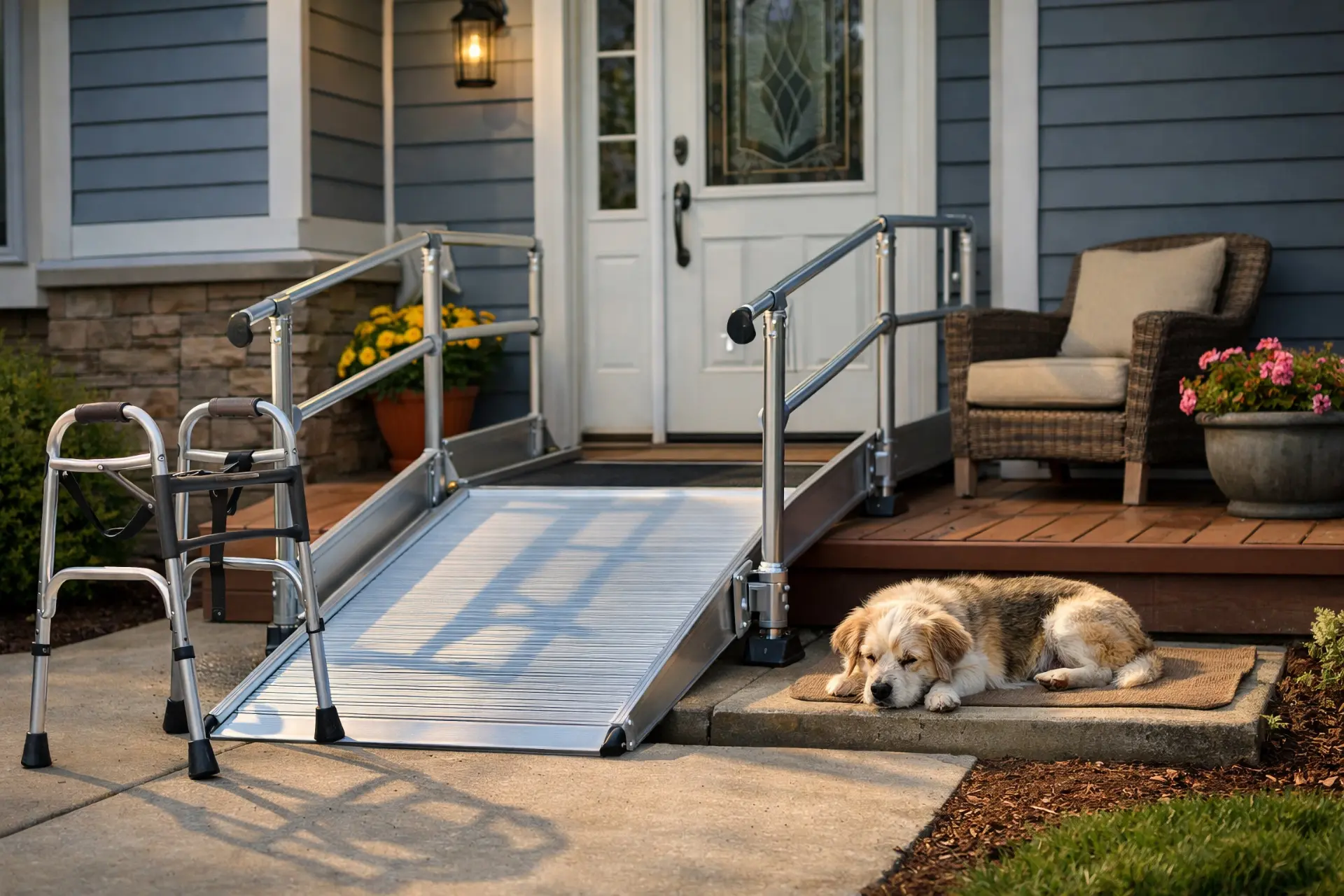
Portable wheelchair ramps are often the first—and smartest—step in an aging-in-place plan. They don’t require permanent installation. They don’t assume the future. They simply solve today’s problem and stay out of the way tomorrow if needed.
HandiRamp’s portable ramps are commonly used at front doors, back doors, and garage entries. They’re ideal for people recovering from surgery, managing early mobility changes, or hosting family members who use walkers or wheelchairs. They’re also a quiet way to prepare for the future without committing to a full remodel before it’s necessary.
These ramps are built from lightweight but strong aluminum, with non-slip surfaces designed for real-world conditions like rain, leaves, and shoes that were not chosen for optimal traction. Some fold for easy storage. Others stay in place. Handrails can be added when stability matters more than minimalism.
Portable ramps are less about permanence and more about control. They give homeowners options, which is exactly what aging in place should preserve.
Threshold Ramps: The Small Fix That Prevents Big Problems
Threshold ramps don’t look like much. That’s kind of the point.
A raised door threshold or sliding door track might only be an inch or two high, but for someone using a walker or wheelchair, that inch can become a daily risk. HandiRamp’s threshold ramps smooth out these transitions so movement through the home feels natural again instead of cautious.
These ramps work well at exterior doors, interior room transitions, and garage entries. They’re modular, subtle, and don’t announce themselves as medical equipment. More importantly, they reduce tripping risk, prevent awkward lifting maneuvers, and eliminate one of the most common sources of household falls.
Falls don’t just cause injuries. They change confidence. Threshold ramps quietly prevent both.
Tap Into your Home Equity
Need to raise some cash to pay for home improvements, or anything else? Get our Guide on Creative Ways to Tap Into Home Equity
Get our Guide!Modular Residential Ramps: A Long-Term Solution That Still Allows Flexibility
When accessibility needs become more consistent, many homeowners move from temporary solutions to something more structured. HandiRamp’s modular residential ramp systems are designed for this phase of aging in place.
These ramps can be configured to fit porches, side entrances, and garage access points. They include proper slope ratios, optional handrails, and landing areas that allow users to pause safely. Unlike poured concrete ramps, modular systems aren’t permanent in a way that locks homeowners into one decision forever.
They can be adjusted, extended, or removed if circumstances change. That matters, because aging is not a straight line. Good accessibility planning allows for recalibration without regret.
Handrails: Stability Is Not Optional, and It’s Not a Weakness
Balance changes with age. That’s biology, not a personal failure.
HandiRamp’s handrail systems support safer movement on ramps and transitions, providing both physical stability and psychological reassurance. Many people don’t realize how much confidence they’ve lost until they regain it by simply having something solid to hold onto.
Handrails reduce hesitation, and hesitation is often what causes falls. In aging-in-place design, confidence is as important as clearance and slope.
Vehicle Access at Home: Independence Doesn’t End in the Driveway
Being able to enter and exit the home safely is only half the independence equation. Leaving the house matters just as much.
HandiRamp offers residential vehicle access ramps that support safe transitions into vans, SUVs, and garages. These ramps are designed for real weight and regular use, not occasional emergencies. They help people maintain mobility beyond the front door, which keeps social lives intact and routines meaningful.
When vehicle access becomes unsafe, isolation tends to follow. Ramps prevent that quiet shrinking of life.
Pet Ramps: Aging in Place Includes the Whole Household
Pets don’t stop aging just because we wish they would.
HandiRamp’s residential pet ramps support aging in place for both pets and their owners. They allow older dogs to climb onto beds or into vehicles without being lifted, which protects joints on ensuring pets and prevents back injuries for humans.
This isn’t a luxury item. It’s a safety solution disguised as kindness.

Time to Downsize?
Discover the joy of letting go! Our guide to Downsizing helps you downsize with ease.
Slip-Resistant Stair Solutions for Homes That Still Have Steps
Not every home can eliminate stairs, and not every homeowner wants to. In those cases, making stairs safer is often the most practical option.
HandiRamp’s slip-resistant stair treads and safety products reduce fall risk in areas where lighting, weather, or simple fatigue make steps more dangerous. They’re especially useful for outdoor stairs, basement access, and garage steps—places where people are less careful because they’ve used them for years.
Familiarity is often what makes stairs dangerous. Safety upgrades counteract that complacency.
Why HandiRamp Works for Aging in Place
HandiRamp’s residential accessibility products work because they respect how people actually live. They don’t force dramatic decisions too early. They don’t assume permanent disability. And they don’t turn homes into clinical spaces.
They allow homeowners to adapt gradually, respond to change, and maintain dignity throughout the process. That’s what aging in place requires—not just equipment, but flexibility.
Final Thoughts
Aging in place isn’t about resisting change. It’s about staying in control as change happens.
HandiRamp’s residential accessibility products remove barriers without removing identity. They support independence without fanfare. And they allow homes to evolve alongside the people who live in them.
Good accessibility doesn’t shout. It just works.
And when it works well, nobody notices—except the people who get to keep living their lives on their own terms.
You Need a Winning Strategy
When it comes to navigating the ocean of resources for older adults, it helps – a lot – to have someone who can show you the way. Book a call with a coach to save time, money, and no small amount of frustration.
Click Here to Book a Call