

Seb Frey is a REALTOR® and founder of Team Sixty Plus, a curated network connecting older adults and their families with trusted professionals across California. With decades of experience helping homeowners 60+ navigate major life transitions—like downsizing, aging in place, or passing on a legacy—Seb brings deep market knowledge, a compassionate approach, and a commitment to simplifying complex decisions. When he’s not advising clients, he’s sharing expert insights on real estate, retirement strategies, and quality-of-life resources for the 60+ community.
In my work with older adults and their families across Silicon Valley, I have a recurring conversation that always ends the same way. We talk through the usual options, including aging in place, downsizing to a 55+ neighborhood, moving into a continuing care retirement community, or relocating closer to the kids. Then I mention one more idea, and the room shifts. “Have you ever looked at a university based retirement community?” Most of the time, the response is some version of, “A what now?”
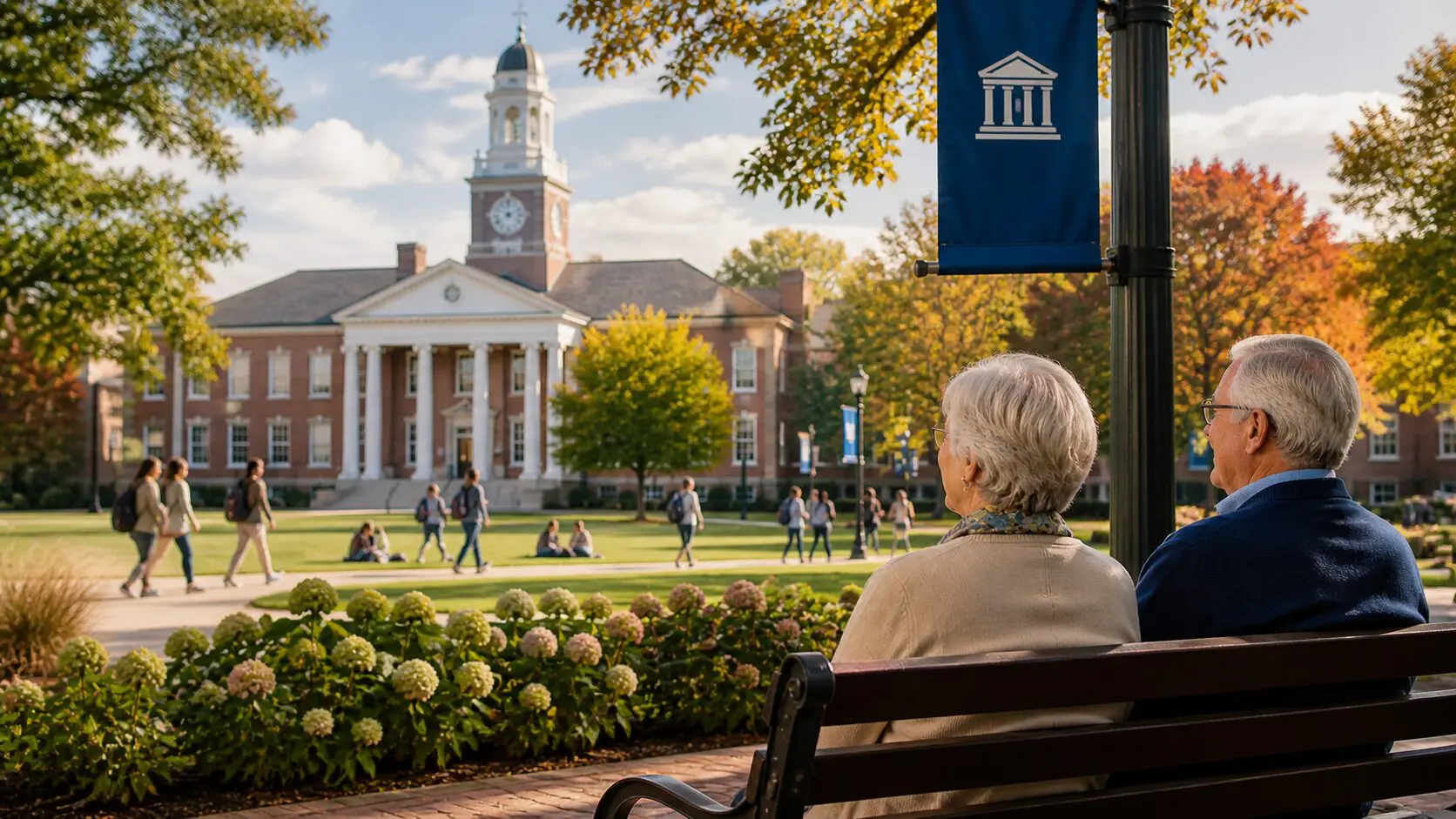
So let’s fix that. University Based Retirement Communities, often called UBRCs, are one of the most interesting and underdiscussed options in senior living today, and they fit beautifully with the way today’s 55+ adults actually want to live. They are intellectually alive, socially rich, and built around the energy of a college campus rather than the quiet of a gated cul-de-sac. If you are an older adult thinking about your next chapter, or an adult child trying to help a parent plan, this is a category you owe it to yourself to understand.
What Is a University Based Retirement Community?
A University Based Retirement Community is exactly what it sounds like, but with more nuance than most people realize. It is a senior living community that has a formal relationship with a college or university, usually located on or directly adjacent to the campus, and built around shared programming, shared amenities, and intergenerational connection between residents and students. A number of communities claim to be UBRCs, but the ones with the best approach meet a specific set of criteria, according to Andrew Carle, faculty and lead instructor for the Program in Senior Living Administration at Georgetown University, and the person who coined the term university-based retirement community.
According to Carle’s widely accepted framework, a true UBRC sits within roughly a mile of its host institution, offers a full continuum of care from independent living through skilled nursing, has formalized programming with the university, includes meaningful financial integration between the two organizations, and has a resident population that is at least ten percent connected to the institution as alumni, retired faculty, or former staff. Communities meeting all five criteria can be classified as University Based Retirement Communities (UBRCs), those meeting three to four criteria as University Linked Retirement Communities (ULRCs), and those meeting one or two criteria as University Affiliated Retirement Communities (UARCs). Most communities you see marketed as UBRCs sit somewhere on this spectrum, and that is worth understanding before you fall in love with one.

got
questions?
Why Older Adults Love University Based Retirement Communities
The demand for these communities is not accidental. It is being driven by a generation that fundamentally rejects the older model of retirement, the one where you move somewhere quiet, take up a hobby or two, and slowly fade. The clients I work with are not interested in fading. They want to keep learning, keep contributing, and keep being around younger people who challenge their thinking. UBRCs give them all of that under one roof.
Lifelong learning is the headline feature, and it really does deliver. Most UBRCs allow retirees who are living on campus to enroll in college classes, which is not only a great way to learn something new and expand your horizons, but it may even be helpful to prevent or delay dementia as you age. Some communities partner with a campus lifelong learning institute that offers non-credit courses designed specifically for older students. Others let residents audit traditional courses alongside undergraduates. A few, like Lasell Village in Massachusetts, actually require ongoing learning hours as part of the residency agreement. The point is, the brain stays engaged in a way that is very hard to replicate in a typical 55+ community where the most stimulating event of the week is bingo night.
The intergenerational piece may matter even more. “Seniors want that open-mindedness, that crucible of energy that happens on college campuses that is awakening and progressive,” and that energy is contagious. Studies from the Mather LifeWays Institute on Aging have shown that residents of Life Plan Communities reported better emotional, social, physical, intellectual, and vocational wellness than older adults who remained at home, and adding the intergenerational component of a university campus expands on each of those benefits. Pen-pal programs, mentoring relationships, shared meals, joint research projects, and casual encounters at the campus coffee shop all add up to something that traditional senior living simply cannot provide.
There are quieter benefits that matter just as much. Many UBRCs sit near top-tier academic medical centers, which means residents have access to outstanding healthcare, clinical trials, and specialists they might not have at home. The cultural calendar is built in, with theater, lectures, concerts, art exhibits, and sporting events available a short walk from your front door. And because most campuses are walkable and well-served by shuttle systems, residents who can no longer drive do not lose their independence the way they would in a more isolated suburban setting.
How Much Does a University Based Retirement Community Cost?
Let me be direct here, because this is where the conversation gets real. UBRCs are not the inexpensive option in senior living. Most are organized as continuing care retirement communities, which means they use a buy-in model where you pay a substantial entrance fee plus an ongoing monthly service fee.
There are 75 to 100 retirement communities associated with an academic institution in the U.S., and most charge an entrance fee that can range from around $180,000 to $2 million, plus a monthly fee that starts at around $3,000 and can climb to $6,000 or more per month, depending on the level of care. The wide range reflects everything that drives senior living pricing in general, including geography, the size and luxury of the residence you choose, the specific services included, and the prestige of the affiliated institution. For example, the entry fee at The Forest at Duke begins at $88,000, while Lasell Village can run up to $900,000 and Longhorn Village at the University of Texas in Austin charges entry fees up to $1.18 million.
Entrance fees usually come with a refundability option, and this is where you really need to read the contract carefully. Some communities offer multiple refundability options, commonly 50, 80, or 90 percent, where a lower-cost entrance fee delivers a lower refund and a higher-cost entrance fee offers a larger refund returned to the resident or their estate when the resident leaves the community. The choice you make depends on your estate planning goals, your liquidity needs, and how comfortable you are putting a large sum at partial risk in exchange for lower monthly costs.
Two more financial points worth knowing. First, Medicare will not pay for long-term custodial care in a UBRC, and Medicaid generally will not either because the typical costs put these communities out of reach of seniors whose incomes qualify them for financial assistance. This is private pay territory, period. Second, because health services are involved, you can often deduct a portion of your entrance fee as prepaid medical expenses, in addition to claiming a percentage of your monthly fees that go to your medical costs, so working with a CPA who understands CCRC contracts is well worth the consultation fee.
Retirement Planning for Older Adults
Are you a little late to the retirement planning game? Get this comprehensive guide and get caught up!
Get the Guide!Where Can You Find a University Based Retirement Community?
UBRCs are scattered across the country, with strong clusters near major research universities in the Sunbelt, the Northeast, and the Midwest. The first retirement communities associated with a university were established at Iowa State University (Green Hills) and Indiana University (Meadowood) in the mid-1980s, however the vast majority of communities have been developed over the past two decades, including communities at Stanford, Duke, Notre Dame, Penn State, and the Universities of Virginia, Florida, and Alabama, among others.
Here in the Bay Area, the most established example is Vi at Palo Alto, which sits on Stanford property and integrates with Stanford’s cultural and medical resources. In Southern California, options near USC, UCLA, and the Claremont Colleges have been discussed for years, with mixed levels of formal university partnership. Outside California, you will find prominent examples in Florida, North Carolina, Massachusetts, Arizona, Pennsylvania, New Hampshire, and Texas, among other states. New ones continue to break ground every year, especially as universities recognize that aging boomers represent both a market opportunity and a way to keep alumni engaged for life.
Is There an Official List of the Most Popular UBRCs?
This is the question I get most often, and the honest answer is that there is no single perfect list, but there are good resources to lean on.
The most authoritative directory lives at UniversityRetirementCommunities.com, which Andrew Carle helped develop. UniversityRetirementCommunities.com is dedicated to being the source for individuals seeking information on, and locations of, retirement communities associated with a university or college. The site uses a tiered certification model so you can see whether a community meets the full UBRC criteria or sits in one of the looser affiliated categories. Communities meeting all five criteria and achieving 85 to 100 points may be certified as a University Based Retirement Community, those meeting three to five criteria and achieving 60 to 80 points may be certified as a University Linked Retirement Community, and those meeting one to three criteria and achieving 35 to 55 points may be certified as a University Affiliated Retirement Community. If you are doing serious research, this should be one of your first stops.
Beyond that directory, the major senior living publications including Caring.com, SeniorLiving.org, Kiplinger, and U.S. News all maintain rankings and write-ups of well-known UBRCs. They each weight different factors, so reading two or three of them gives you a fuller picture than relying on any single source. And of course, anyone working with a senior living advisor or a real estate professional who specializes in aging, like me, can help you build a personalized shortlist based on what actually matters to you and your family.
Family Guide for Aging in Place
For Families with Older Adults who are looking to help with a Parent with Aging in Place!
Get the GuideFour University Based Retirement Communities Worth Knowing About
Here are four communities that consistently come up in conversations about top UBRCs, chosen to give you a feel for how varied this category really is. Each one represents a different model, a different price point, and a different lifestyle, and each one is worth a closer look if any of them resonate.
Vi at Palo Alto, Stanford University, California
For my Silicon Valley clients, this is the closest thing to a true UBRC in the immediate area, and it sets a very high bar. Located in the heart of Silicon Valley, Vi at Palo Alto is a Life Plan community situated on 23 acres of Stanford Property, directly across from Stanford Shopping Center and a short distance from Stanford Hospital. It operates as a Type A, or inclusive, Life Plan Community, where a Type A contract provides the most comprehensive continuing care coverage and generally provides for transfer to any of the community’s care venues for an unlimited time at little or no additional cost beyond the monthly fee paid while residing in independent living.
What makes Vi work for so many of my clients is the combination of location, healthcare access, and lifestyle. Stanford lectures, performances, and athletic events are minutes away, and the community runs an active calendar of its own. The price reflects the location and the quality, and Vi is consistently described as one of the more expensive options in the country, but for a Silicon Valley family that wants to stay near family, doctors, and lifelong networks, it is often the right answer.
Mirabella at Arizona State University, Tempe, Arizona
Mirabella represents the most ambitious version of the UBRC model anywhere in the country. Arizona State University in Tempe welcomed its newest class when the UBRC Mirabella at ASU opened its doors in 2020, and the 20-story continuing care retirement community sits right on the ASU campus, which puts older adults right at the center of the college culture. This is not a community next to a campus. This is a community on the campus, in a high-rise tower, with students and faculty as part of daily life.
The integration runs deep. Mirabella at ASU offers a pen-pal program to connect seniors and students, and residents have access to ASU classes, performances, athletics, and research. For older adults who want to live in a true urban college environment rather than a quiet residential setting, Mirabella is hard to beat. It also tends to attract a younger 55+ demographic than many traditional CCRCs, which changes the social feel of the place in ways many residents find energizing.
Tap Into your Home Equity
Need to raise some cash to pay for home improvements, or anything else? Get our Guide on Creative Ways to Tap Into Home Equity
Get our Guide!Oak Hammock at the University of Florida, Gainesville, Florida
Oak Hammock has been around longer than most UBRCs and has built an excellent reputation for combining academic engagement with Florida-friendly weather and amenities. While residents have the ability to audit classes on the University of Florida campus, the on-site Institute for Learning in Retirement brings classes taught by university professors right to Oak Hammock, which lowers the barrier to participation for residents who do not want to commute to campus for every class.
The pricing here is more accessible than at the high end of the market, with a real range depending on the contract you choose. At Oak Hammock at The University of Florida, the standard entrance fee for a Life Care contract ranges from $177,000 to $584,000 for one person, increasing to $231,000 to $771,000 for the 50% refundable plan and $345,000 to $1.045 million for the 95% refundable plan. If you have always loved the Gators, the Florida lifestyle, and the idea of staying intellectually busy in a warm climate, this one belongs on the list.
Lasell Village at Lasell University, Newton, Massachusetts
Lasell Village is the UBRC for people who really, truly want to keep learning, because they will not let you opt out. Lasell Village shares a 13-acre campus with Lasell University, and each resident commits to a minimum of 450 hours per year of learning and fitness activities. That requirement is unique in the senior living world, and it shapes the entire culture of the community. People who choose Lasell are choosing it precisely because they want to be held to that standard.
As a continuing care retirement community, Lasell Village offers independent living residences with one and two bedroom apartments and full kitchens, plus supportive care through Lasell Studios and short-term and long-term skilled nursing, so you can age in place even as your needs change. The campus is in the Boston suburbs, with all the cultural and medical resources of greater Boston within easy reach. Lasell sits at the higher end of the price range, but for the right resident, the structure and the intellectual rigor are exactly what they want.

Everyone Needs a Little Help Sometimes
There’s so much to know when it comes to lifestyle choices for Older Adults, it’s hard to know even where to begin. One way is to simply click on the button below and let one of our coaches give some guidance – at no cost to you.
Get Help NowWhy This Style of Retirement Living Works for So Many People
If I had to summarize why I keep recommending UBRCs to certain clients, it would come down to this. The 55+ adults I work with today are not the same people who retired in the 1990s. They have more education, more curiosity, more energy, and more years of healthy life ahead of them than any generation before. They want their next chapter to be additive, not subtractive. They want their living environment to match the way they actually live, which means being around interesting people of all ages, having access to ideas and culture, and feeling like they are part of something bigger than themselves.
A UBRC delivers all of that, while also solving the harder questions about long-term care, healthcare access, and aging in place that families really do need to think about, ideally before a crisis forces the conversation. The buy-in is significant, and the financial planning around an entrance fee deserves real attention from a CPA and a financial advisor. But for the right person, the trade is more than fair, because what you are buying is not just a residence. You are buying a community, a continuum of care, and a daily life that keeps your mind, body, and social world fully engaged for the years ahead.
If you or a parent are weighing options for the next move, I would put University Based Retirement Communities on your shortlist alongside the more traditional choices, even if you have never considered one before. Tour two or three. Talk to current residents, who are usually wonderfully candid. Bring your adult children into the conversation early. And work with someone who understands both the real estate side and the aging side of this decision, because the two are inseparable, and getting it right is one of the most important things you will do for the next chapter of your life.
If you want help thinking through whether a UBRC is right for your family, or how to structure the sale of a current home to fund an entrance fee, that is exactly the kind of conversation I have with families every week. The good news is that there are more options than most people realize, and once you know they exist, the next chapter starts to look a lot more interesting than the brochures usually make it sound.
You Need a Winning Strategy
When it comes to navigating the ocean of resources for older adults, it helps – a lot – to have someone who can show you the way. Book a call with a coach to save time, money, and no small amount of frustration.
Click Here to Book a Call