
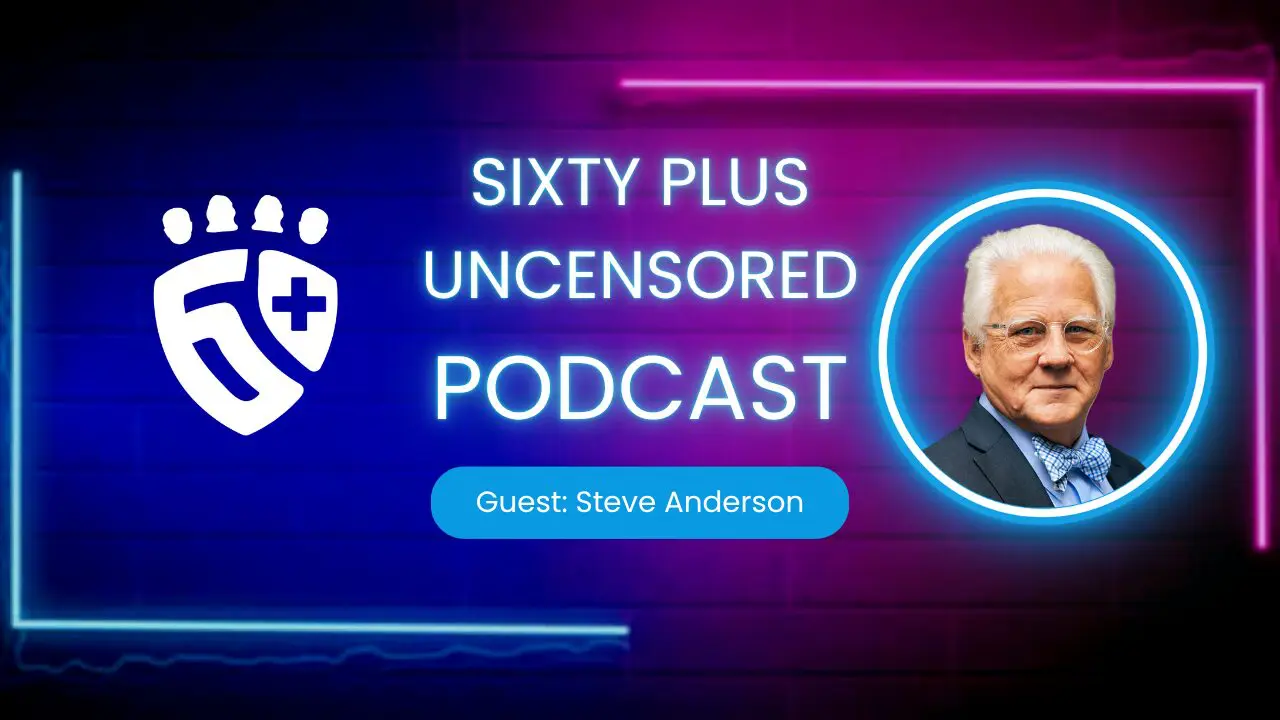
In this episode of Sixty Plus Uncensored, host Seb Frey talks with Steve Anderson, a longtime technology consultant to the insurance industry and the author of The Bezos Letters: 14 Principles to Grow Your Business Like Amazon. Steve spent decades helping independent insurance agents adopt new technology, starting in the late 1990s when few people believed the internet would amount to much. Along the way, he became fascinated by a simple question: why do some successful companies keep growing while others disappear? His search for an answer led him to Jeff Bezos’s annual letters to Amazon shareholders, and eventually to a book that became a Wall Street Journal and USA Today bestseller and has been translated into 22 languages. In this conversation, Steve shares the Amazon principles that matter most for small businesses and solopreneurs, how he reinvented his own career in his sixties, and why he believes experience gives older adults an edge when it comes to using artificial intelligence.
From Insurance Technology to Bestselling Author
Steve’s path to writing a book grew directly out of his work in insurance, an industry built entirely around managing risk. As technology kept accelerating, he began to suspect that the biggest risk a business can take is actually not taking enough risk. Companies that sit back and protect what they have, he noticed, often end up disappearing. That idea sent him researching businesses that had been successful and were now gone, and others that had kept thriving for decades.
Amazon stood out, and so did the letters Jeff Bezos wrote to shareholders each year. Unlike most shareholder letters, which tend to be dry and promotional, Bezos’s letters explained how he was actually growing the company. Steve first condensed each letter into a one-page summary of key takeaways, intending it as a free giveaway. When he showed it to his wife, who works in book publishing, she told him it wasn’t a giveaway, it was a book. Eighteen months later, with her help as editor and book strategist, The Bezos Letters was published in the fall of 2019.
Steve also explains the three main ways to publish a book today. Traditional publishers, like the “big five,” are difficult to break into, and authors usually sign over the rights to their work. Self-publishing through platforms like Amazon’s Kindle Direct Publishing gives authors full control, but they have to learn everything from cover design to interior layout themselves. Steve chose a third route, a hybrid publisher, which handles the professional publishing work while allowing the author to keep his intellectual property. For anyone over 60 thinking about writing a book to share their expertise, it’s a useful overview of the options.
Four Cycles of Growth: Test, Build, Accelerate, Scale
Steve organizes Amazon’s 14 growth principles into four cycles that he believes every business goes through, whether it’s a brand-new side hustle or a company that’s been around for decades: test, build, accelerate, and scale. Businesses are always testing new ideas, building on what works, accelerating that growth, and then scaling it. In the conversation, he focuses on the principles that resonate most with the people he speaks to.
Encourage Successful Failure
The first principle in the test cycle is to encourage successful failure. As Steve explains, real growth requires experimentation, and real experiments sometimes fail. If an experiment turns out exactly as you predicted, it isn’t an experiment, it’s confirmation. The question is what you learn from the failure.
Amazon’s best-known example is the Fire Phone. Launched in 2014, it arrived after most people had already chosen an iPhone or an Android device, and few saw a reason to switch. By the end of that year, Amazon wrote off about $170 million in inventory and development costs. But the voice-processing technology the team developed for the phone went into a new product announced just months later: the Echo and Alexa, which grew into a multibillion-dollar business. The failure became a stepping stone.
Seb raises the obvious concern for solopreneurs: most small business owners can’t afford to lose millions on an experiment. Steve agrees, and his answer is to scale your experiments to what you can afford to lose. Bezos himself started out packing books on his hands and knees in his garage and driving them to the post office. The lesson isn’t to take big gambles, but to take small, incremental steps and build on what works. Steve adds that people aren’t really afraid of failure. They’re afraid of the consequences of failure, which is why it helps to keep experiments small enough that a miss won’t sink you.
Obsess Over Customers
In the build cycle, the first principle is to obsess over customers. Steve points out that most businesses talk about customer focus or the customer journey, but Bezos deliberately chose the word “obsess.” In his view, you can’t be too obsessed with your customers. The goal is to understand their wants and needs so deeply that you can invent things on their behalf.
Steve shares several examples. In the early 2000s, Amazon began allowing third-party sellers to list products on its own pages, even when those sellers had better prices or products Amazon didn’t stock. It seemed crazy at the time, but Bezos reasoned that what was better for the customer would ultimately be better for Amazon. Today, third-party sellers account for roughly 60 percent of Amazon’s sales. Amazon also invented one-click shopping to remove the hassle of entering your name, address, and credit card every time you bought something, and protected that idea with a patent for 17 years. Then came Prime, created to eliminate another point of friction: shipping costs. Bezos’s team was against it at first, but Prime members now spend far more on Amazon than non-members.
For a solopreneur, the takeaway is practical: find the small points of friction your customers experience, then experiment with ways to remove them.
Make High-Velocity Decisions
In the accelerate cycle, Steve highlights the principle of high-velocity decisions. One thing the companies that failed had in common, he says, is that their decision-making slowed down as they grew and added layers of management.
Bezos describes two kinds of decisions. “Door one” decisions are major, hard-to-reverse choices, like whether to sell a company. Those should be made slowly and carefully, with as much information as possible. “Door two” decisions are easily reversible, and they should be made quickly, with about 70 percent of the information you wish you had, by the people closest to the work. If you walk through a door two and don’t like what you see, you can simply turn around. The problem, Bezos warns, is that growing companies start treating every decision like a door one decision. For a small business owner, recognizing which decisions are easily reversible can free you to move faster and try more.
It’s Always Day One
The final principle, in the scale cycle, is the idea that it’s always day one. In his very first shareholder letter in 1997, Bezos wrote that it was “day one” for the internet and for Amazon, and he ended nearly every letter afterward with the same reminder. The idea is to hold on to the energy and urgency of the very first day you opened for business.
Steve recounts a story Bezos shared in his 2016 letter to shareholders. At an all-hands meeting, an employee asked what “day two” looks like. Bezos answered that day two is stasis, followed by irrelevance, followed by excruciating, painful decline, followed by death. Steve says he saw that same progression when he studied companies like BlackBerry, Blockbuster, and Sears. BlackBerry, for example, dominated business email but its leaders didn’t believe people would want a glass keyboard or that phones would be used to browse the internet. The iPhone proved them wrong.
Bezos named four practices that help a company stay in day one: customer obsession, a skeptical view of proxies like customer surveys (instead of actually talking to customers), eagerly adopting external trends, and high-velocity decisions. Notably, he identified artificial intelligence and machine learning as one of those trends back in 2016.
Staying in a “day one” mindset applies to people as much as to companies, and Why a Growth Mindset Matters at Any Age explores how curiosity and a willingness to keep learning help you keep growing well past sixty.
Stop Innovating, Start Inventing
Steve recently gave a TEDx talk titled “Stop Innovating, Start Inventing.” His point isn’t that innovation is bad, but that it isn’t enough. If a business only keeps improving what it already has, someone else may invent something that makes it irrelevant.
He offers Amazon Web Services as a prime example of invention. Amazon built a world-class technology infrastructure to run its own store, and then someone asked what Steve calls the inventor’s question: what if we rented this platform to others? AWS dramatically lowered the cost of launching a new online business, from millions of dollars in equipment to a few thousand dollars in rented computing power that can scale almost instantly.
He also shared the story of a Brazilian marketer with no coding experience who used AI tools to build a phone app that lets women quickly look up public safety information about a blind date or other stranger. Within three months, it had 10,000 users. Steve’s takeaway is that AI doesn’t make invention safer, but it does make it cheaper and faster. You can test ideas and find out you’re wrong far more quickly than before.
Reinventing a Career in His Sixties
Steve’s own life is a case study in reinvention. After the book came out in 2019, he planned to build a career as a keynote speaker and had a full calendar of events for 2020. Then the pandemic hit, and nearly every event moved online. Around the same time, several state insurance agent associations approached him with an idea to help their members with technology. Steve spent the next three to four years building and launching that business, then stepped away as planned. He describes himself as an idea person rather than a maintenance person and admits he gets bored easily.
Today, he’s updating The Bezos Letters, working on ideas for a second book, rebuilding his speaking career, and exploring how AI can help business owners grow. And he has no interest in stopping just because he’s reached a traditional retirement age. As he puts it, he still likes what he’s doing, so why stop? He notes that more people are working past 65, some because they want to and some because they need to.
If you’re thinking about how to keep earning on your own terms, Part-Time Work With Purpose: Top Opportunities for Retirees looks at flexible, meaningful ways to put your experience to work, and what they pay.
How AI Can Help a Solopreneur Over 60
Seb asks how AI could meaningfully help a typical 65-year-old insurance agent, realtor, or other one-person business. Steve divides AI use into two categories.
The first is operational: using AI to handle everyday work. AI is good at comparing documents, reviewing contracts and policies, and organizing information. Steve uses it to audit 20 years of computer files and folders, clean up podcast transcripts, and even prepare a pre-interview brief before each podcast appearance, including the host’s background, the audience, and the questions he’s likely to be asked.
The second is what Steve calls leverage: using AI as a thought partner. If you’re retiring from a long career but not ready to be done, you can describe your experience to an AI tool and ask what you might be good at next, or how your skills could help others. Steve also uses AI to challenge his own thinking. Before his TEDx talk at the Harvard Club of Boston, he asked AI to describe the likely audience, point out holes in his logic, and suggest what he was missing.
Most importantly, Steve believes that experience, or age, gives older adults an advantage with AI. People who have spent decades in business know which questions to ask, how to probe deeper, and when an answer doesn’t sound right. Used as a thought partner rather than a simple search engine, AI can sharpen your thinking rather than replace it.
If you’re building a business or side income from home, Easy Digital Skills So Anyone Can Work From Home covers the practical tech basics that make it easier to get started.
Your Experience Is Your Advantage
What ties this conversation together is a mindset more than a set of business tactics: run small experiments, learn from what doesn’t work, stay obsessed with the people you serve, make reversible decisions quickly, and never slip into the comfortable “day two” habit of protecting what you already have. Steve Anderson is living proof that those principles apply to careers as much as to companies. In his sixties, he wrote a bestselling book, built and handed off a new business, gave a TEDx talk, and is now exploring what AI makes possible. For listeners who wonder whether it’s too late to start something new, his answer is clear: your experience isn’t a liability in a fast-changing world. It may be your greatest advantage.
To learn more, visit The Bezos Letters website, where you can also try The Bezos Letters Experience, an AI tool trained on Steve’s book and interviews that answers your business questions. You can also connect with Steve on LinkedIn by searching for Steve Anderson, author.