
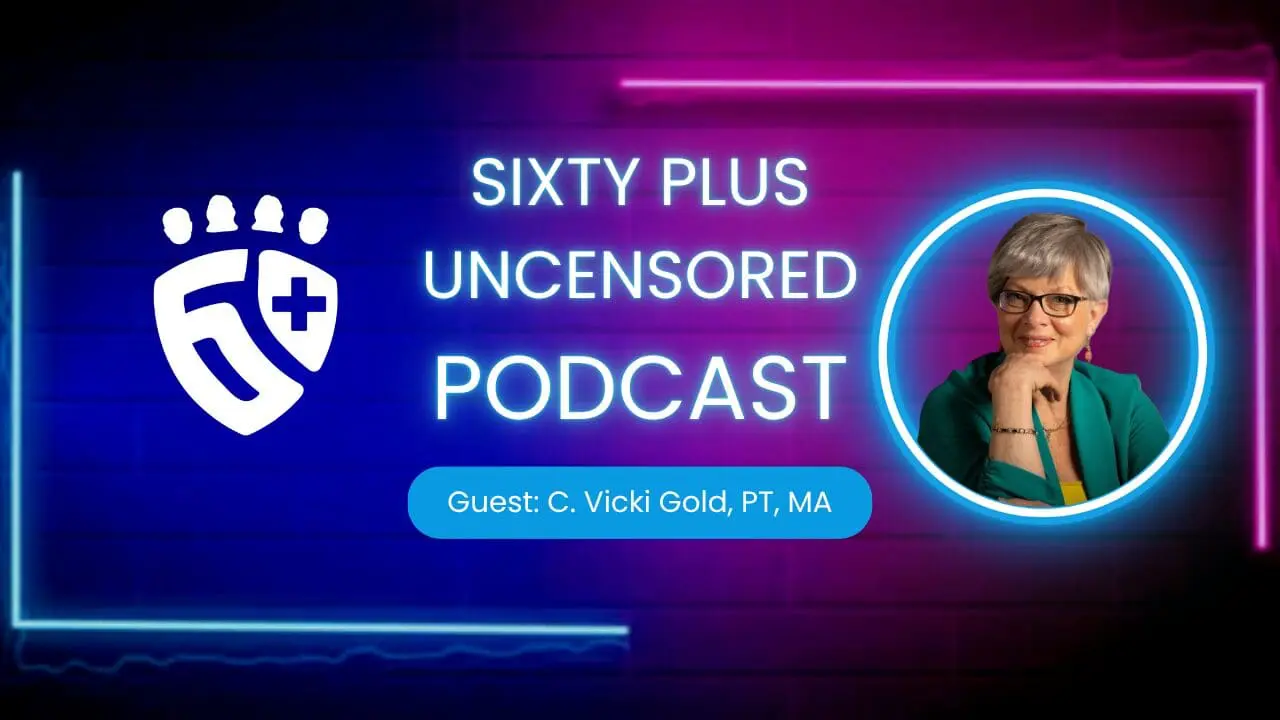
In this episode of Sixty Plus Uncensored, host Seb Frey sits down with C. Vicki Gold, a retired physical therapist, movement educator, and lifelong advocate for healthy aging. Now in her early eighties, Vicki continues to teach, write, and inspire others through her work on posture, movement, breathing, and mindset. Drawing on more than five decades of clinical experience, she shares practical ways older adults can improve their health, confidence, and quality of life, often through simple habits anyone can start today. Their conversation explores why aging well is about much more than exercise, and how small daily choices can help people remain active, independent, and engaged throughout later life. Vicki shares the daily habits behind her youthful vitality and how anyone can start using them.
Aging Well Begins with How You Think
When people talk about aging, the conversation often centers on things we cannot control. Genetics, illness, aches and pains, or the natural changes that come with growing older tend to dominate the discussion. While those factors certainly matter, Vicki believes another influence is just as important: our mindset. At 81 years old, Vicki surprises almost everyone she meets. She moves with remarkable ease, stands tall with excellent posture, speaks with enthusiasm, and carries herself with the energy of someone decades younger. When people ask for her secret, they often expect to hear about a miracle supplement or an unusual exercise routine. Instead, she begins with something much simpler. Attitude.
According to Vicki, maintaining a youthful outlook is one of the strongest foundations for healthy aging. Genetics may play a role, and healthy habits certainly matter. However, the way people think about themselves, about aging, and about what is still possible has an enormous influence on how they experience later life. That does not mean pretending life is easy or ignoring physical limitations. It means choosing curiosity over resignation, possibility over defeat, and growth over decline. Many people unknowingly begin limiting themselves long before their bodies require it. They stop learning, stop moving, stop trying new things, or assume they are simply “too old.” Those beliefs quietly become self-fulfilling. Vicki’s message is refreshingly different: aging does not mean giving up. It means learning how to work with your body more wisely.
Readers interested in building a more resilient outlook on aging may also enjoy Why a Growth Mindset Matters at Any Age, which explores how embracing curiosity, adaptability, and lifelong growth can positively shape the aging experience.
A Lifetime of Learning Began Early
Vicki’s passion for helping others did not begin in adulthood. As a young child, she was exposed to disability through her younger brother, who was born with profound developmental disabilities. A few years later, one of her close friends became quadriplegic after contracting polio. Rather than making her uncomfortable around people with physical challenges, these experiences had the opposite effect. They gave her empathy and confidence around individuals living with disabilities. Then, at just fifteen years old, a counselor at summer camp noticed how naturally she interacted with children who had physical disabilities and suggested she consider becoming a physical therapist. That single conversation changed her life.
Unlike many teenagers who frequently change career aspirations, Vicki never looked back. She pursued physical therapy and spent more than fifty years practicing in hospitals, rehabilitation centers, educational settings, and private practice. Throughout those decades, she continued learning beyond traditional medicine, studying yoga, Pilates, Tai Chi, the Alexander Technique, Feldenkrais Method, and numerous mind-body approaches. Rather than viewing these disciplines as competing philosophies, she saw them as complementary pieces of a much larger picture. Movement, posture, breathing, awareness, and mindset all work together.
Why Movement Is About More Than Exercise
Many people assume that staying healthy simply means exercising more. Exercise is certainly valuable, but Vicki believes movement should be approached differently. Instead of viewing exercise as something you do for thirty minutes before returning to poor movement habits for the rest of the day, she encourages people to improve the way they move during everyday life.
- Every time you stand up.
- Every time you sit down.
- Every time you bend over.
- Every time you carry groceries.
- Every time you walk across a room.
These ordinary activities become opportunities to reinforce healthier movement patterns. This perspective is especially important for older adults because daily movement affects balance, joint health, strength, and injury prevention far more often than occasional workouts. Rather than separating “exercise” from the rest of life, Vicki teaches people to integrate better movement into everything they do.
The ABC Mind-Body System
One of the central ideas in Vicki’s work is what she calls the ABC Mind-Body System. The system is intentionally simple because simple ideas are often easier to remember and practice consistently.
The first letter, A, stands for Alignment. Good posture is not about looking elegant or standing stiffly. Proper alignment allows the body to move more efficiently while reducing unnecessary strain on muscles and joints. Many people spend years slouching without realizing how much tension it creates throughout the body. Improving posture often reduces discomfort while making breathing and movement easier.
The second letter, B, stands for Breathing. Most people breathe automatically without giving it much thought. Vicki encourages making breathing conscious, especially during stressful moments. Interestingly, she places greater emphasis on exhaling than inhaling. Slow, controlled exhalations help release tension, reduce stress, and prepare the lungs to receive fresh oxygen more effectively. Rather than forcing deep breaths, she teaches people to simply slow down their exhalation and let the inhalation happen naturally.
The third letter, C, represents Centering. Centering means allowing the mind and body to work together instead of functioning separately. How often do people trip because they are distracted? How often do they rush through a task without paying attention? Mindfulness during movement reduces accidents while helping people feel more connected to what their bodies are doing. Together, alignment, breathing, and centering create the foundation for healthier movement throughout the day.
If you’re looking to build these habits into everyday life, The Power of Routine: Building Structure in Retirement offers practical ways to create daily routines that support physical health, mental clarity, and overall well-being.
Why Posture Matters More Than Many People Realize
Posture may seem like a small issue compared to major health concerns, yet it influences almost everything we do. Poor posture affects breathing, balance, mobility, joint stress, muscle fatigue, and even confidence. Many older adults gradually lose height over time, partly because years of poor posture allow the spine to collapse forward. Vicki teaches people to think less about “standing straight” and more about creating length through the body. Rather than forcing the shoulders back unnaturally, she encourages imagining the body becoming longer while allowing the chest to open comfortably.
Simple mental cues can often produce dramatic improvements. She recommends thinking about lengthening through the crown of the head, allowing the shoulders to relax naturally, opening the chest, and gently drawing the chin backward instead of allowing the head to drift forward. These adjustments may seem subtle, but practiced consistently, they become habits that improve both comfort and movement.
Building Core Strength Without Traditional Crunches
One surprising part of Vicki’s philosophy involves core strength. Many people immediately think of sit-ups or crunches when they hear the phrase “strengthen your core.” She disagrees. Traditional crunches strengthen muscles differently than those primarily responsible for supporting posture. Instead, she focuses on developing the deeper abdominal muscles that stabilize the spine throughout everyday movement. Simple exercises performed while sitting can activate these muscles without placing unnecessary stress on the back. She also points out that people with osteoporosis should be especially cautious about repeated spinal flexion exercises like crunches because they may increase the risk of compression fractures. Instead of pursuing dramatic abdominal workouts, Vicki emphasizes gentle strengthening that supports healthy posture and safe movement.
Slow Movement Creates Better Movement
Modern life encourages speed. People rush through daily tasks, often paying little attention to how they move. Vicki recommends the opposite. Slowing down creates awareness. When someone deliberately lowers themselves into a chair instead of collapsing into it, the muscles work harder. Balance improves. Strength develops naturally. Slow movement also gives the brain time to recognize unsafe positions before they become injuries. This is one reason practices like Tai Chi have demonstrated benefits for balance and fall prevention. Moving slowly is not a sign of weakness. Often, it reflects greater control.
Balance Starts at the Ground
Falls remain one of the leading causes of injury among older adults. Many balance programs focus on strengthening the hips or improving reaction time, but Vicki believes another area deserves more attention. The feet. Our feet constantly communicate with the brain about where the body is positioned. Healthy feet provide valuable sensory information that helps maintain stability. Unfortunately, many people ignore foot health until significant problems develop. Vicki encourages older adults to care for their feet, improve awareness of how they stand, and recognize that balance begins from the ground up. Good posture, proper alignment, strong core muscles, and healthy feet all work together. No single element solves the problem alone.
For additional ways to reduce fall risk and stay independent, see Top 10 Things to Do to Reduce the Risk of Falling in Your Home, which shares practical safety strategies that complement better balance and movement.
Breathing as a Tool for Calm
Stress affects every stage of life, but many older adults experience new sources of anxiety related to health, finances, caregiving, or changing family roles. One of the simplest tools Vicki teaches requires no equipment at all is Breathing. Rather than focusing on taking huge breaths, she encourages people to emphasize long, gentle exhalations. Exhaling activates the body’s relaxation response. It helps reduce tension while making room for fresh oxygen during the next inhalation. The beauty of this practice lies in its simplicity. There are no complicated routines or strict timing requirements. Whenever stress appears, pause. Slowly breathe out. Then allow the next breath to arrive naturally. Practiced regularly, this simple habit becomes an accessible form of stress management throughout the day.
Small Habits Become Lifelong Habits
People often ask how to create lasting change, and Vicki’s answer is refreshingly practical: don’t try to change everything at once. Instead, begin by simply becoming more aware. Notice when you are slouching, when you are rushing through your day, or when stress starts to build. Then make one small adjustment, stand a little taller, slow your breathing, or move with greater intention. The goal is not perfection but repetition. Over time, these small choices become automatic, and healthy habits develop not through willpower alone, but through consistent practice until they simply become part of the way you live.
The Power of Self-Talk
One of the most memorable stories Vicki shared involved an elderly patient who repeatedly insisted, “I can’t.” The woman refused to believe she could stand or walk. After exhausting every strategy, Vicki stopped trying to convince her otherwise. Instead, she simply asked her to replace “I can’t” with “I’ll try.” That small shift changed everything. Moments later, the woman stood, walked the length of the parallel bars, turned around, and returned safely to her chair.
The story illustrates a powerful truth. The words people repeat to themselves shape their expectations, behaviors, and ultimately their results. Replacing certainty of failure with willingness to try creates space for progress. This principle extends far beyond rehabilitation. Whether learning technology, improving fitness, starting a new hobby, or rebuilding health after illness, the first barrier often exists in our own thoughts.
Purpose Keeps Us Moving
Toward the end of the conversation, Seb asked Vicki why she continues working so passionately at an age when many people choose complete retirement. Her answer was immediate. Purpose. Helping others gives her energy. Writing her book, teaching healthy movement, speaking with older adults, and continuing to learn all contribute to a sense that her work still matters. Purpose does not have to involve publishing books or giving presentations. For some people, purpose means caring for grandchildren. For others, it means volunteering, mentoring, gardening, creating art, learning new skills, or supporting neighbors. The specific activity matters less than having a reason to get up each morning.
Purpose provides direction. Direction encourages movement. Movement supports health. Health allows people to continue living meaningful lives. The cycle reinforces itself.
It’s Never Too Late to Learn Something New
One misconception about aging is that older adults cannot change long-established habits. Vicki rejects that idea completely. Throughout her career, she has watched people improve posture, balance, confidence, mobility, and overall quality of life well into their eighties and nineties. The process may require patience. Progress may happen more gradually than it once did. But improvement remains possible. Her own life reflects that philosophy. Even after retiring from clinical practice, she continues writing, learning, teaching, and expanding her work. Rather than viewing age as a reason to stop growing, she sees it as another opportunity to keep learning.
Lifelong learning is one of the strongest predictors of healthy aging. How Lifelong Learning Keeps Your Brain Sharp After 60 explains why continuing to learn new skills can benefit both cognitive health and overall quality of life.
Conclusion: Healthy Aging Happens One Choice at a Time
Healthy aging is rarely the result of one dramatic decision. Instead, it is built through thousands of small choices repeated over months and years. Standing a little taller, breathing a little slower, moving with greater awareness, strengthening the body gently but consistently, replacing “I can’t” with “I’ll try,” and finding purpose in each new season of life may seem like small actions on their own. Together, however, they create habits that support greater strength, confidence, and independence over time. Vicki Gold’s decades of experience remind us that aging well is not about chasing perfection or trying to look younger. It is about giving the body and mind the attention they deserve, respecting what they can still do, and continuing to grow regardless of age. The years ahead may bring new challenges, but they can also bring greater wisdom, resilience, confidence, and fulfillment. With the right mindset and a willingness to keep learning, healthy aging becomes less about simply adding years to life and more about adding life to those years.