
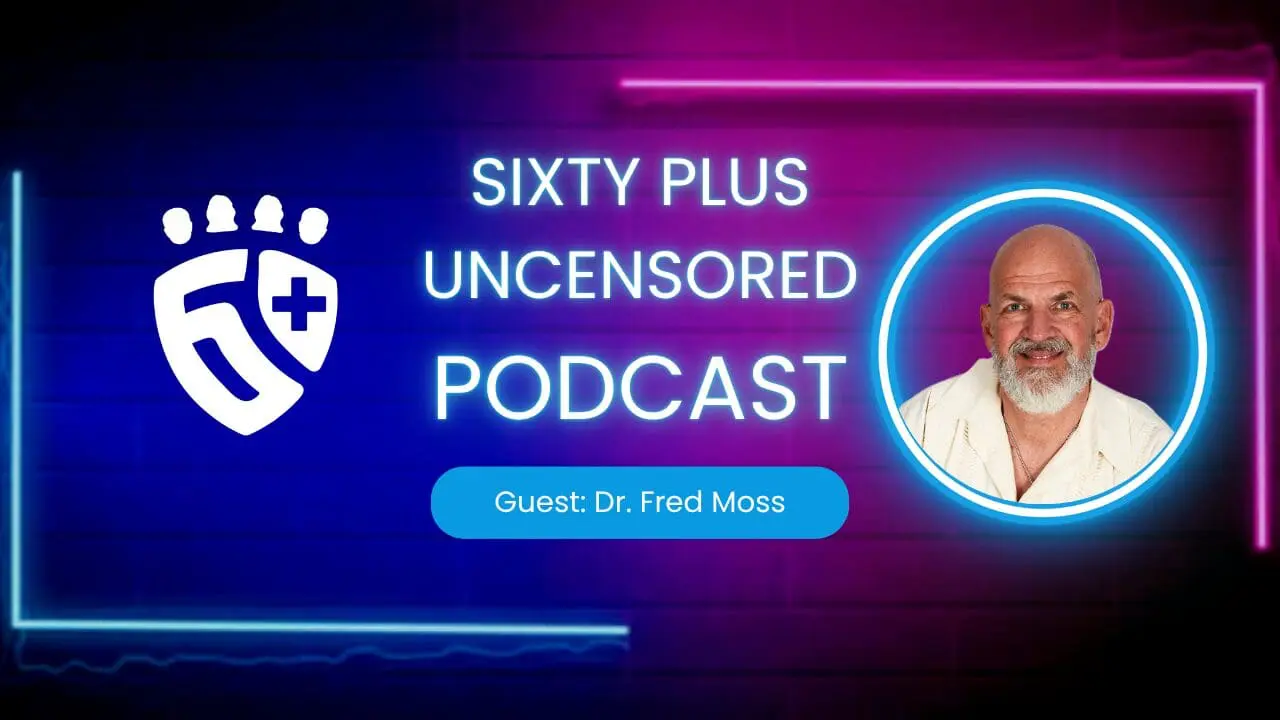
In this episode of Sixty Plus Uncensored, host Seb Frey sits down with Dr. Fred Moss, a psychiatrist with nearly four decades of experience who has spent much of his career questioning the very system he once worked inside. Now known by many as “The Undoctor,” Dr. Fred has become an outspoken advocate for a more human-centered approach to emotional well-being, one rooted not in labels or prescriptions, but in communication, connection, creativity, and authenticity. Together, they explore why so many people feel unseen by the modern mental health system, how isolation quietly shapes emotional suffering later in life, and why genuine human connection may still be one of the most powerful forms of healing available to us. He makes a compelling case for mental health beyond medication, rooted in connection.
The Search for Authenticity in a World Full of Labels
One of the first things Dr. Fred makes clear is that his life’s work has never simply been about psychiatry. Long before he entered medical school, he was fascinated by communication itself. He describes communication as the center of human experience, the place where healing, understanding, and connection all begin. In many ways, his entire professional journey has been shaped by a desire to understand how people relate to each other and how honest conversation changes lives. That desire did not begin inside a classroom. In fact, Dr. Fred openly shares that he dropped out of college multiple times because traditional education never felt aligned with what he truly wanted to do. Eventually, he found himself working at a state mental health facility for adolescent boys. For the first time, he felt like he was doing meaningful work. He was talking with people, listening to them, connecting with them, and seeing firsthand how being understood could create change. Ironically, it was during that period that he also developed serious concerns about the direction psychiatry was heading. He felt increasingly uncomfortable with a system that seemed more interested in categorizing people than understanding them. Yet instead of walking away from the field entirely, he chose to enter it more deeply, hoping he could help bring humanity back into mental health care. That tension between professional expectations and personal values stayed with him for years. Dr. Fred describes feeling a kind of “duplicity” during much of his career, a disconnect between what he was being asked to do professionally and what he genuinely believed helped people heal. Eventually, that conflict became impossible to ignore.
Readers exploring the importance of emotional authenticity and personal growth later in life may also appreciate Why a Growth Mindset Matters at Any Age, which looks at how staying open to change and self-discovery can create a more grounded and fulfilling aging experience.
Why So Many People Feel Failed by the Mental Health System
A major theme throughout the conversation is Dr. Fred’s belief that many people feel deeply disappointed by their experiences within the mental health system. He is careful not to criticize individual therapists or psychiatrists personally. In fact, he repeatedly emphasizes that most professionals enter the field because they genuinely want to help people. His criticism is aimed more at the structure of the system itself.
According to Dr. Fred, modern psychiatry often encourages people to define themselves by diagnoses. A person walks into an office struggling with stress, sadness, anxiety, exhaustion, grief, or confusion, and leaves carrying a label that begins to shape how they see themselves moving forward. Over time, those labels can quietly become identities. He argues that once people begin identifying themselves primarily through diagnoses, it can narrow how they think about their own potential. Instead of seeing emotional struggles as part of the broader human experience, they may begin believing something is fundamentally wrong with them.
One of Dr. Fred’s most repeated ideas during the conversation is deceptively simple: maybe there is nothing wrong with you. That statement is not meant to dismiss emotional pain or deny that people suffer deeply. Rather, it challenges the assumption that every painful emotional experience must automatically be framed as pathology. Life itself can be difficult, especially as people age, experience loss, face uncertainty, or navigate loneliness and major transitions. For many older adults, this idea can feel surprisingly liberating. After decades of responsibilities, setbacks, disappointments, grief, family stress, financial pressure, health concerns, and changing identities, emotional exhaustion is not necessarily evidence of defectiveness. Sometimes it is evidence of being human.
Communication as the Heart of Healing
Perhaps the strongest idea woven throughout the conversation is Dr. Fred’s belief that communication sits at the center of emotional healing. He repeatedly returns to a simple but familiar experience: when someone truly listens to us during a difficult moment, we often feel better almost immediately. Not because our problems disappear, but because we feel seen, heard, and understood. That moment of connection changes something internally. For Dr. Fred, this is not a small thing. He believes human beings are fundamentally wired for connection and that much of emotional suffering becomes worse when people feel isolated, dismissed, misunderstood, or disconnected from others.
This perspective becomes especially important when discussing depression. Rather than viewing depression strictly as a medical malfunction, he describes it as something deeply tied to how people interpret their lives, relationships, purpose, and circumstances. When someone loses direction, purpose, connection, or hope, emotional heaviness can naturally follow.
What stands out in the conversation is that Dr. Fred does not offer simplistic positivity. He does not suggest people should simply “think happy thoughts” or ignore painful realities. Instead, he talks about the importance of perspective, communication, and reconnecting with meaning. He explains that powerful conversations can help people see their lives differently without denying their experiences. A conversation cannot erase grief, loneliness, regret, or hardship, but it can help someone feel less trapped inside those experiences.
For older adults, this insight matters deeply. Many people over 60 quietly experience emotional isolation even when surrounded by others. Retirement can remove daily social interactions. Adult children may live far away. Long marriages sometimes drift into emotional distance. Friends pass away. Communities change. Over time, people can begin to feel invisible. Dr. Fred’s message is that healing often begins not with fixing ourselves, but with reconnecting to other human beings.
The conversation around connection and emotional well-being pairs well with How Lifelong Learning Keeps Your Brain Sharp After 60, which highlights how staying socially and mentally engaged can support both cognitive and emotional health later in life.
The Quiet Epidemic of Isolation Later in Life
Seb Frey brings up an important reality during the conversation: many older adults genuinely feel like they have nobody to talk to. Some have lost spouses. Others live alone. Some feel emotionally disconnected even within their marriages or families. Many no longer know where they belong socially. Dr. Fred acknowledges the pain of this experience while also gently challenging the belief that connection is impossible. He points out that communication does not always require intimate lifelong relationships. Connection can begin in surprisingly ordinary places. A coffee shop conversation, a local community group, a library event, an online discussion, a volunteer opportunity, or even creative expression can become forms of meaningful communication. Importantly, he expands the definition of communication beyond talking. Music, writing, art, dancing, gardening, cooking, singing, and creativity itself can all become ways people reconnect with themselves and others. This broader view of communication feels especially valuable for aging adults who may struggle with social anxiety, grief, mobility limitations, or emotional hesitation. Not every meaningful connection begins with deep conversation. Sometimes it begins with shared activity, creativity, or simple presence.
The discussion also touches on fear. Many people avoid connection because they fear judgment, humiliation, rejection, or embarrassment. Dr. Fred describes this as one of the central tensions of being human. People often learn to hide parts of themselves to avoid vulnerability. Over time, that protective instinct can become isolating. Yet he argues that fear itself does not actually prevent action. Fear may remain present, but people still have choices about whether they move forward despite it. In other words, courage is not the absence of fear. It is the willingness to proceed while fear still exists. That perspective can be incredibly important later in life, especially for people trying to rebuild community after loss, divorce, retirement, illness, or major transitions. Reaching out socially after years of isolation can feel deeply uncomfortable. But meaningful connection often begins with small acts of vulnerability.
Service to Others as a Path Toward Purpose
Another major theme throughout the discussion is the role of service in creating a meaningful life. Seb Frey reflects on the idea that one of the deepest forms of fulfillment may come from helping others. Dr. Fred strongly agrees, describing service as one of the most powerful ways people reconnect with themselves and the world around them. Importantly, he does not present service as self-sacrifice in the unhealthy sense. Rather, he describes it as alignment. When people act in ways that genuinely reflect their values and humanity, life often feels more grounded and purposeful.
This idea becomes especially relevant after 60, when many people begin reevaluating their identities. Careers may end. Children become independent. Longstanding routines disappear. Questions about meaning naturally become more important. For some people, retirement creates freedom. For others, it creates disorientation. The structure and identity provided by decades of work suddenly vanish, leaving people uncertain about what comes next. Dr. Fred suggests that service can become a stabilizing force during this stage of life. Helping others creates connection, perspective, and purpose simultaneously. Whether through mentoring, volunteering, caregiving, teaching, listening, community involvement, or simple acts of kindness, service reminds people that they still matter deeply.
This perspective also challenges a common cultural assumption that aging is primarily about decline. Throughout the conversation, Dr. Fred speaks passionately about the value older adults still bring to the world. He believes people over 60 possess enormous wisdom, resilience, and emotional insight gathered through decades of lived experience. Rather than shrinking with age, he argues many people have the potential to become more grounded, more authentic, and more impactful later in life.
The discussion about fulfillment through helping others fits naturally alongside Creating a Fulfilling Lifestyle After Retirement, which explores practical ways older adults can build purpose, structure, and meaning during retirement years.
Rethinking Personal Responsibility and Emotional Struggles
One of the more provocative aspects of the conversation involves Dr. Fred’s views on personal agency and emotional ownership. He repeatedly encourages people to remember that they still possess choices, even during difficult emotional periods. This does not mean emotional suffering is imaginary or easy to overcome. Rather, he emphasizes that people are not completely powerless inside their lives.He applies this perspective to depression, anxiety, addiction, fear, and even identity itself. While acknowledging that life can be painful and overwhelming, he argues that individuals still retain some ability to shape their responses, perspectives, actions, and relationships moving forward. For some listeners, this message may feel empowering. For others, it may feel challenging. Yet underneath it is a broader theme about reclaiming authorship over one’s life story. Dr. Fred repeatedly returns to the idea that human beings are not merely passive recipients of diagnoses, circumstances, or past experiences. Even when life becomes messy or painful, people still possess the ability to make choices about how they move forward. This perspective can be especially meaningful later in life when people begin feeling trapped by long-established identities or emotional patterns. Aging does not eliminate the possibility of growth, change, creativity, or reinvention.
The Role of Fellowship and Community in Recovery
The conversation also explores addiction and recovery, particularly through the lens of fellowship programs like Alcoholics Anonymous and Narcotics Anonymous. Although Dr. Fred questions many traditional psychiatric approaches, he speaks positively about the power of human fellowship within recovery communities. He notes that one of the strongest aspects of programs like AA is the sense of unconditional acceptance many participants experience. People enter those rooms carrying shame, fear, regret, loneliness, and emotional pain, yet they are met by others who understand their struggles firsthand. That sense of belonging can become deeply healing. Again, the conversation returns to the same central principle: connection matters. For many people struggling emotionally, the greatest pain is not simply the symptom itself. It is the feeling of being alone inside it. Community changes that experience. Shared humanity changes that experience. Being understood changes that experience.
This idea extends far beyond addiction recovery. Older adults facing grief, isolation, caregiving stress, health challenges, retirement confusion, or emotional exhaustion often benefit enormously from environments where honest conversation feels safe and welcomed. Unfortunately, modern culture does not always make those spaces easy to find. Many people spend years hiding emotional struggles behind politeness, busyness, or self-sufficiency. Over time, that emotional isolation can become exhausting. Dr. Fred’s larger message is that healing rarely happens entirely alone.
Why Aging Does Not Mean Losing Vitality
Toward the end of the conversation, Seb comments on Dr. Fred’s visible energy and enthusiasm at age 68. It is a moment many listeners will likely relate to because society often associates aging with slowing down, withdrawing, or losing relevance. Dr. Fred’s response is refreshingly honest. He does not claim to have endless energy or perfect emotional stability. In fact, he openly acknowledges that he still experiences dark moments, fear, pain, uncertainty, and emotional struggles.That honesty is important because it pushes back against another harmful cultural expectation: the idea that emotionally healthy people must always appear positive, productive, or energized. Instead, Dr. Fred describes vitality as something connected to purpose. When he feels aligned with meaningful work, service, and communication, he experiences renewed energy and motivation. Purpose becomes fuel.
This perspective offers a much more realistic and compassionate vision of aging. Emotional fulfillment is not about achieving permanent happiness or emotional perfection. It is about staying connected to meaning, authenticity, relationships, creativity, and contribution even while life remains imperfect. For many older adults, this may actually become easier with age. Decades of experience often create greater self-awareness, emotional perspective, and clarity about what truly matters.
The Importance of Staying Human
One of the most powerful undercurrents throughout the conversation is Dr. Fred’s repeated invitation to embrace humanity rather than constantly trying to escape it. Modern culture often pushes people toward endless optimization, self-improvement, performance, productivity, and emotional management. Yet many people quietly feel exhausted trying to become idealized versions of themselves. Dr. Fred’s philosophy moves in a different direction. Instead of constantly asking, “What is wrong with me?” he encourages people to ask, “What if being human already includes all of this?” Pain, uncertainty, loneliness, fear, grief, confusion, joy, creativity, connection, and vulnerability are all part of the human experience. Aging does not remove those realities. If anything, it often deepens them. But aging can also deepen wisdom, perspective, compassion, resilience, and authenticity.
Throughout the episode, Dr. Fred repeatedly emphasizes the importance of reconnecting with one’s core self. Not the performance version created for approval, but the more honest and grounded version underneath it all. For many people over 60, this stage of life becomes an opportunity to finally move closer to that authenticity.
The episode’s broader message about embracing humanity and emotional honesty connects well with Exploring Spirituality After Retirement: A Journey to Meaning, Peace, and Connection, which reflects on how deeper self-awareness and inner connection can become increasingly valuable later in life.
Final Thoughts
This conversation between Seb and Dr. Fred is ultimately less about psychiatry itself and more about what it means to be human in a world where many people feel disconnected, overwhelmed, or emotionally unseen. Whether listeners fully agree with all of Dr. Fred’s views or not, the broader themes resonate powerfully: communication matters, connection matters, purpose matters, and human beings need each other more than modern culture often admits. For older adults especially, the conversation offers an important reminder that life does not stop becoming meaningful after retirement, after loss, or after major transitions. In many ways, later life can become an opportunity to reconnect with authenticity, rediscover purpose, and deepen relationships in ways that earlier decades often did not allow. The discussion also challenges the idea that emotional struggles automatically mean something is broken beyond repair. Sometimes people are not failing at life. Sometimes they are simply human beings trying to navigate difficult experiences without enough connection, support, meaning, or understanding. And perhaps most importantly, the episode reminds listeners that healing often begins with something surprisingly simple: honest human connection. Even in a world filled with technology, diagnoses, distractions, and endless noise, people still heal through being seen, heard, understood, and accepted by one another. That truth may be far older than psychiatry itself, and according to Dr. Fred Moss, it may still be one of the most powerful forms of healing we have.