

Seb Frey is a REALTOR® and founder of Team Sixty Plus, a curated network connecting older adults and their families with trusted professionals across California. With decades of experience helping homeowners 60+ navigate major life transitions—like downsizing, aging in place, or passing on a legacy—Seb brings deep market knowledge, a compassionate approach, and a commitment to simplifying complex decisions. When he’s not advising clients, he’s sharing expert insights on real estate, retirement strategies, and quality-of-life resources for the 60+ community.
There’s a quiet conversation happening in clinics, longevity centers, and Silicon Valley wellness studios right now, and it’s about a test most people have never heard of. It’s called the DEXA scan, and if you’ve spent any time around the longevity world or talked with a doctor about bone health, the term has probably crossed your radar. For everyone else, it’s still flying under the radar, which is a shame, because it might be one of the most useful pieces of information you can gather about your own body, especially after you cross fifty.
I spend a lot of time talking with older adults and their families about what it really means to age well. The conversation almost always starts with the house. People want to know whether to stay put, whether to downsize, whether the stairs are going to become a problem in ten years. But every one of those conversations eventually circles back to something deeper, which is the body. Will it hold up? Will mom still be able to live alone? Will I be the kind of person who can travel, chase grandkids, and stay active into my eighties? The answers to those questions are rarely about luck. They’re almost always about preparation, and preparation requires knowing what you’re working with. That’s where the DEXA scan comes in.
What a DEXA Scan Actually Measures
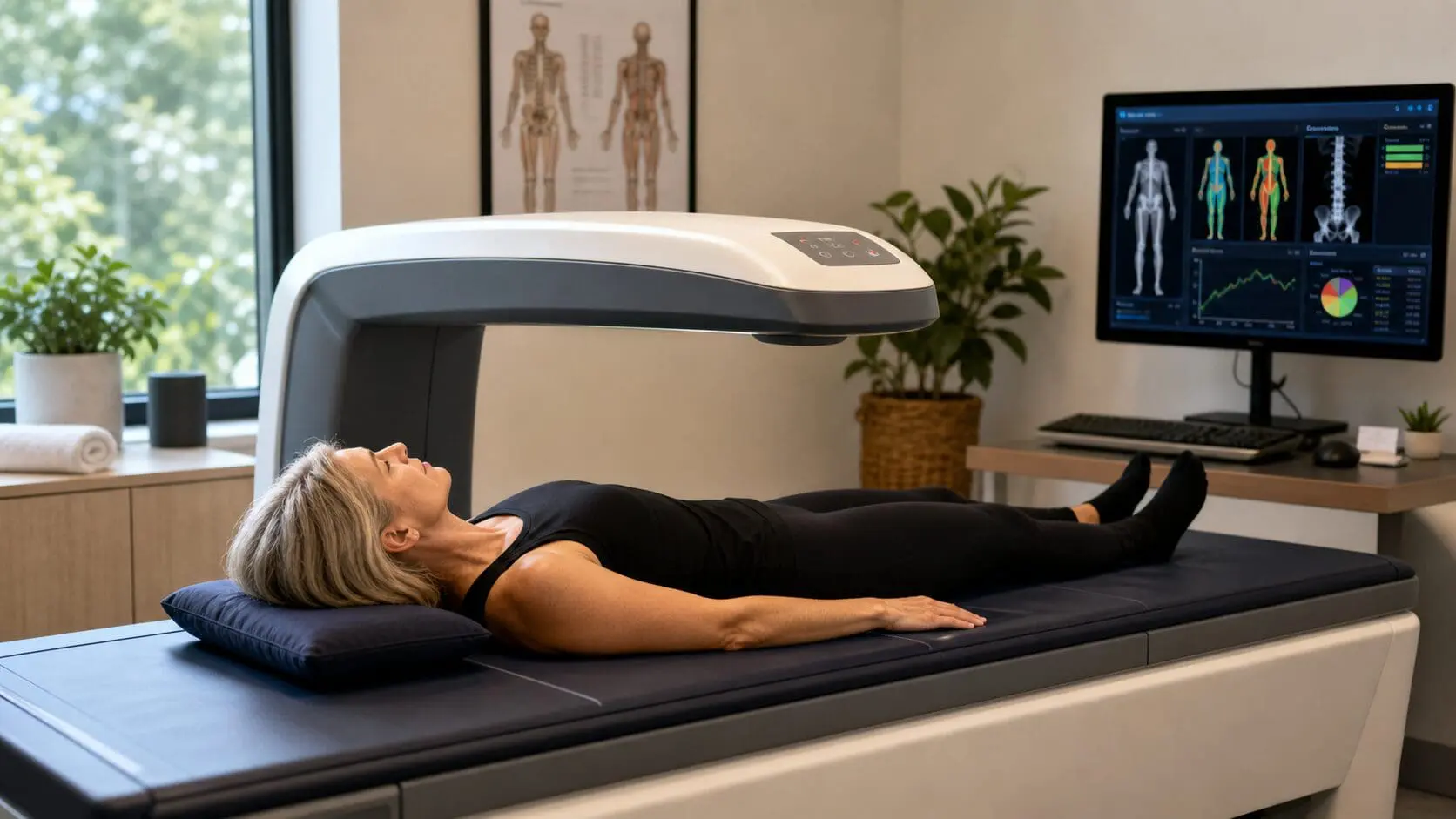
DEXA stands for dual-energy X-ray absorptiometry, which is a mouthful that essentially means a low-radiation imaging test that breaks down what your body is made of. In about six to ten minutes of lying still on a padded table, the machine produces a complete map of your body composition. We’re talking about exactly how much muscle you carry and where it lives, how much body fat you have and where it’s distributed, how much fat is wrapping around your organs, and how dense your bones are. It’s an honest snapshot, and there isn’t a piece of equipment in your home that can come close to it.
The bathroom scale tells you a number. Your BMI tells you a slightly more useful number, but still a flawed one. A DEXA scan tells you the truth. It separates fat from lean tissue from bone, which is information your scale will never give you. And that distinction matters more than most people realize, because two people who weigh the same can be in radically different health situations. One might be carrying twenty pounds too much fat around the midsection while quietly losing muscle. The other might be in great shape with healthy bones and balanced body composition. The scale would call them identical. The DEXA would call them what they actually are.
In the medical world, DEXA scans have been around since the seventies, originally developed to screen for osteoporosis. That’s still a primary use, and a critical one, but the technology has expanded into something much more comprehensive. Modern body composition DEXA scans give you a full readout of metrics that, frankly, your annual physical doesn’t even attempt to measure. T-scores and Z-scores for bone density, fat mass index, lean mass index, appendicular lean muscle ratios, visceral fat numbers, side-to-side asymmetries, and a regional breakdown showing exactly where on your body things are happening. It’s a level of insight that, until recently, was only available to elite athletes and research subjects.
Maximizing Your Social Security
Many People Miss Out on $100,000+ In Social Secuirty Benefits! Don’t be one of them. Our Clear and Complete Guide Explains It All
Get the Guide!The Muscle Question Nobody Is Asking You
Here’s something that doesn’t get enough attention in a regular doctor’s visit. Starting around age thirty, the average adult begins to lose muscle mass at a slow but steady rate. By the time someone hits sixty, they may have lost fifteen percent of their lean muscle without realizing it, and by eighty, that number can climb to thirty percent or more. The medical name for this is sarcopenia, and it’s quietly responsible for a huge share of the falls, fractures, and loss of independence that we associate with getting older.
The cruel thing about sarcopenia is that it’s often invisible. People don’t notice they’re getting weaker because the change is so gradual. The grocery bag feels a little heavier. The stairs take a little more effort. Standing up from a low chair becomes a project. By the time anyone connects the dots, the person has lost a meaningful amount of functional strength and is much closer to the cliff than they realize. And once you’ve crossed certain thresholds, the climb back is steep. The earlier you can see the trend, the easier it is to reverse it.
A DEXA scan catches sarcopenia early. It doesn’t just tell you your total muscle mass, it breaks it down by region. You can see exactly how much muscle you have in your arms, in your legs, even compare your right side to your left. If your appendicular lean mass starts trending down at fifty-five, that’s a wake-up call you can act on. If you wait until eighty, when you’re already struggling to get up from the floor, you’ve lost a lot of runway.
This is the part of the DEXA story that gets me most excited when I talk with families about aging in place. We obsess over whether someone’s home has good lighting and a walk-in shower, which matters, but we don’t talk nearly enough about whether the person living in that home has the muscle to use it safely. A DEXA scan, taken in your fifties or sixties and revisited every couple of years, gives you the kind of data that lets you actually do something about it. The home matters, but so does the body inside of it.
We’re All In This Together
Bone Density and the Silent Fracture Risk
The other half of the DEXA story is bones. The scan measures bone mineral density, which is the gold standard for assessing osteoporosis risk. Osteoporosis is a condition where bones become porous and fragile, and it leads to fractures that can be catastrophic, especially in older adults. Hip fractures in particular are devastating. A meaningful percentage of people who break a hip after seventy never fully recover their independence, and a not-insignificant portion don’t survive the year following the fracture. We talk a lot about preventing falls, but the truth is that fall prevention starts long before you fall. It starts with the bones.
Most people associate bone density loss with postmenopausal women, and the link is real. Estrogen plays a major role in maintaining bone, and when it drops, bones can lose density quickly. But this isn’t only a women’s issue. Men lose bone density too, just on a slower timeline, and a meaningful number of men over seventy have osteoporosis without knowing it. Anyone with a family history, a sedentary lifestyle, certain long-term medications, or a history of disordered eating earlier in life is at higher risk than they probably realize. The Bone Health and Osteoporosis Foundation now recommends bone density screening for all women over sixty-five and all men over seventy, and earlier than that for anyone with risk factors.
What I love about bone density data from a DEXA scan is that it’s actionable. If your T-score comes back showing the early stages of bone loss, you have time to do something about it. Resistance training, especially weight-bearing exercise, is one of the most effective ways to maintain and even rebuild bone density. Adequate protein, vitamin D, calcium, and in some cases prescribed medications can all change the trajectory. But none of those interventions get triggered if nobody is measuring, and too many people only learn about their bone loss after a fracture, when it could have been caught years earlier with a simple scan.
Retirement Planning for Older Adults
Are you a little late to the retirement planning game? Get this comprehensive guide and get caught up!
Get the Guide!Visceral Fat, the Fat You Can’t See
There’s another category of information a DEXA scan provides that I think gets overlooked, which is visceral fat. This is the fat that wraps around your internal organs deep in your abdomen, and it behaves very differently from the fat under your skin. Visceral fat is metabolically active in ways that drive inflammation, insulin resistance, cardiovascular disease, and even cognitive decline. It’s strongly linked to almost every major chronic disease of aging, from type 2 diabetes to Alzheimer’s.
The frustrating thing is that you can have very little visible belly fat and still be carrying a problematic amount of visceral fat. Skinny people get it too, which is sometimes called being skinny-fat. A DEXA scan measures visceral adipose tissue with real precision, which is something you simply cannot get from a tape measure or a bathroom scale. Once you know your number, you can track it. Lifestyle changes around diet, exercise, and stress management can move it, but again, you need the baseline to know whether what you’re doing is working. Otherwise you’re flying blind.
For families thinking about long-term health planning, this is huge. Visceral fat is one of the strongest predictors of whether someone will develop the kinds of chronic conditions that limit independence in later life. Catching it early and reducing it is one of the highest-leverage things a person can do for their healthspan, which is a word I want everyone over fifty to know. Lifespan is how long you live. Healthspan is how long you live well, with energy, mobility, and clarity of mind. The two are very different things, and visceral fat sits right at the intersection.
Medicare Made Simple
Medicare can be complicated – so let us break it down for you! Get our quick and easy guide, Medicare Made Simple!
Get the Guide!Why a DEXA Scan Matters More After Fifty
There’s a window in life when DEXA scans go from being a nice-to-have to being a genuinely powerful tool, and it opens up around age fifty. By this point, most people have already started losing muscle and bone, even if they don’t feel it yet. Hormonal changes are accelerating those losses. Old habits, the ones that worked when you were twenty-five, are quietly stopping work. The amount of activity that used to keep you in shape is no longer enough. Your body is a different machine, and the operating manual has changed.
Without data, you’re guessing. You might be doing yoga three times a week and feeling great, but losing significant muscle in your legs because you aren’t lifting any weight. You might be eating what you’ve always eaten and slowly gaining visceral fat without seeing it on the scale. You might be taking calcium supplements and assuming your bones are fine, when in reality your density is falling faster than your supplement can keep up with.
A DEXA scan removes the guesswork. You get a snapshot of where you are, and if you come back in twelve or eighteen months for another scan, you get to see exactly what changed and why. It turns aging from something that happens to you into something you can manage and respond to.
What to Expect at a DEXA Appointment
If you’ve never had one, here’s roughly what to expect. You arrive in form-fitting athletic clothing with no metal, so leggings and a fitted shirt or sports bra work well. You’ll need to remove jewelry, watches, and anything with zippers or underwire. The scan itself involves lying flat on a padded table while a low-radiation X-ray arm passes slowly above you. The dose of radiation is tiny, far less than what you’d get on a cross-country flight, so it’s safe for routine use and even for repeated use over many years.
The actual scanning takes about six to ten minutes, depending on the provider and the machine. The bigger value, though, comes from the analysis afterward. A good DEXA provider doesn’t just hand you a printout and send you on your way. They sit down with you and walk through every metric in detail, explain what it means in the context of your age, sex, and goals, and help you understand what to do with the information. This is where Bay Area readers have a real advantage, because we have a few outstanding providers right in our backyard.
If you’re in Silicon Valley or the broader Bay Area and looking for a place to start, Kalos is my go-to recommendation. They have locations in San Francisco, Palo Alto, and San Jose, which covers most of the Peninsula and South Bay, and what sets them apart is the depth of their analysis. Their team is made up of certified personal trainers and data scientists, which is an unusual combination, and it means you walk out of the appointment not just with numbers but with a real understanding of what to do next. Their introductory scan is currently around eighty dollars, the appointment runs about thirty minutes including the consultation, and they’re HSA and FSA eligible, which makes the cost very manageable. For families in the area who want a baseline scan for an aging parent, or for adults in their fifties and sixties who want to take charge of their own healthspan, it’s a genuinely practical place to start.
Family Guide for Aging in Place
For Families with Older Adults who are looking to help with a Parent with Aging in Place!
Get the GuideHow to Actually Use Your DEXA Data
Getting the scan is only half the battle. The other half is using the information to change something. Here’s the framework I encourage people to think about, especially older adults and the family members helping them plan ahead.
If your bone density numbers are in the lower range, it’s time to add resistance training to your weekly routine if it isn’t already there. Walking is wonderful, but walking alone doesn’t put enough stress on bones to maintain density past a certain age. Lifting weights, ideally with a qualified trainer who understands older bodies, is the single most effective intervention for bone health that doesn’t involve medication. Combine that with adequate protein, vitamin D, calcium, and consistent sleep, and you’re doing the work that genuinely moves the numbers.
If your muscle mass is lower than expected, especially in your arms and legs, the prescription is similar. Build a strength training habit. Two or three sessions a week is plenty for most people. Focus on compound movements like squats, deadlifts, presses, and rows, and progress slowly. The goal isn’t to look like a bodybuilder. The goal is to have enough functional strength to live the life you want at seventy-five and eighty-five. Functional strength is what lets you carry your own grocery bags, climb the stairs to your bedroom, and pick up a grandchild without throwing out your back.
If your visceral fat is elevated, the conversation becomes about metabolic health. Reducing refined carbs and added sugars, prioritizing protein and fiber, getting good sleep, and managing stress all play a role. So does regular movement, including both cardio and strength work. It doesn’t have to be dramatic to work, but it does have to be consistent. Small daily choices compound over months and years, and visceral fat tends to respond well to those compounded efforts when you stick with them.
The beauty of a DEXA scan is that you can come back in a year and see whether what you did made a difference. That feedback loop is what makes the test so powerful. Without it, you’re just hoping. With it, you actually know, and that knowledge becomes the fuel for staying consistent.

Time to Downsize?
Discover the joy of letting go! Our guide to Downsizing helps you downsize with ease.
Aging Well Isn’t About Avoiding Aging
I want to close with a thought I share often when I’m working with families on planning the next chapter. Aging well isn’t about looking thirty when you’re seventy. It’s about having the strength, capacity, and health to live the life you want, in the home you love, with the people you care about. It’s about being the kind of grandparent who gets down on the floor with the kids and gets back up without help. It’s about traveling, hiking, and chasing the things that matter to you. It’s about staying in your home for as long as it makes sense, and making the move on your own terms when it doesn’t.
None of that happens by accident. It happens because someone gathered information, made decisions, and put in the work. A DEXA scan is one of the most useful pieces of information you can gather, and at the prices and locations available now, especially here in Silicon Valley, there’s almost no reason not to start. Whether you’re in your fifties and want a baseline, in your sixties and ready to get serious about prevention, or in your seventies and curious about where you stand, the data will be useful. The next ten or twenty years of your life are still being written, and a DEXA scan helps you write them on purpose.
If you’ve been thinking about getting one, consider this your nudge. Book the appointment. Bring the results to your doctor. Share them with your trainer or your family. And then do something real with what you learn. That last part, the doing something with it, is what separates the people who age on purpose from the people who let aging happen to them.
