
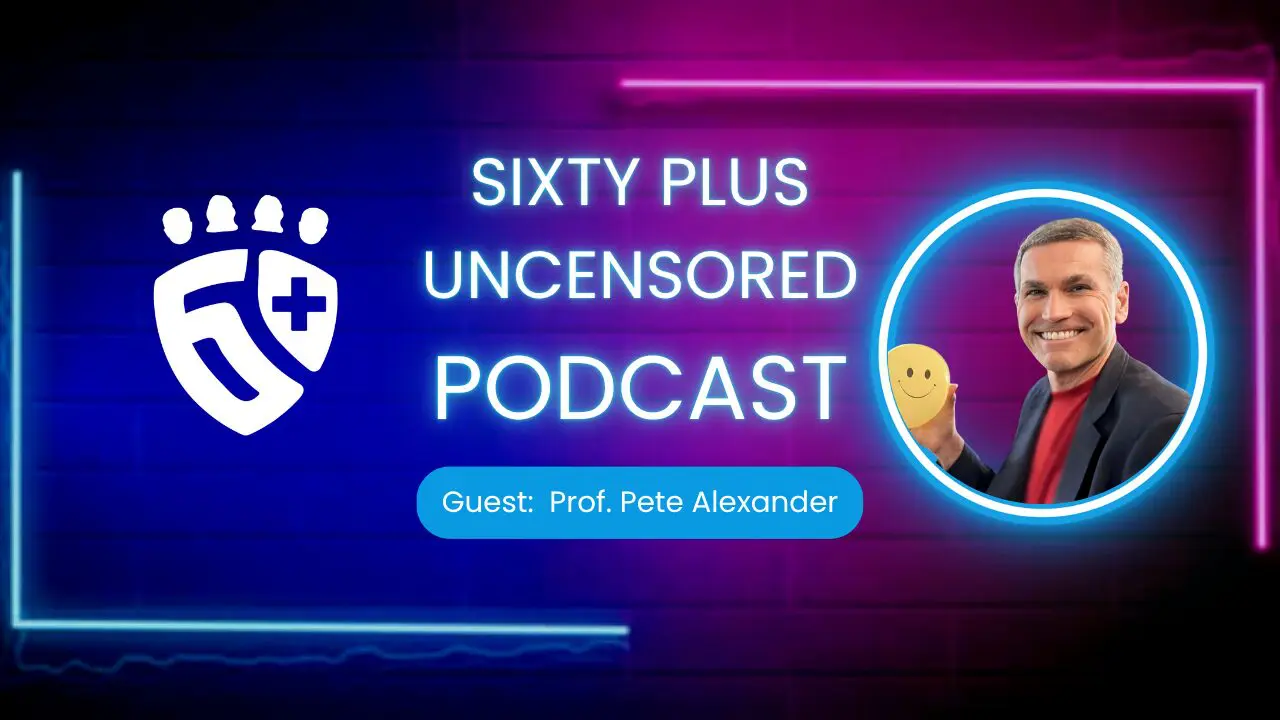
In this episode of Sixty Plus Uncensored, host Seb Frey sits down with Professor Pete Alexander, a former marketing professor, business owner, and laughter yoga ambassador whose life took an unexpected turn after a serious health crisis. Their conversation moves through humor, stress, and the quiet ways our daily habits shape long-term health. Rather than offering quick solutions, Pete shares a perspective grounded in lived experience, one that invites reflection, small changes, and a willingness to listen to the signals our bodies often send long before we truly notice them. He shares how the power of laughter helped him rebuild his health after a serious scare.
A Life That Looked Successful, Until It Wasn’t
On paper, Pete Alexander’s life followed a path that many would recognize as successful and stable. He built a strong career in marketing, taught students from around the world, and stepped into demanding leadership roles within corporate environments. Alongside these responsibilities, he also managed his own business, balancing multiple commitments in a way that likely appeared productive and admirable to others. From the outside, it looked like a life that was full, purposeful, and moving in the right direction.
But beneath that steady progress, something else was quietly building. Like many professionals, Pete had grown used to operating under constant pressure. Long hours, high expectations, and the need to consistently perform had become part of his normal routine. At first, these pressures didn’t seem alarming. In fact, they often felt like signs of ambition and responsibility, reinforcing the idea that staying busy meant staying valuable.
The challenge with stress, however, is that it rarely presents itself in obvious ways. It does not always arrive as a clear warning or a dramatic breakdown. More often, it appears subtly, through fatigue, tension, or small physical signals that are easy to dismiss or explain away. Over time, those signals can become part of everyday life, making it difficult to recognize when something deeper is happening.
For Pete, those early signs were present, but they didn’t feel urgent enough to address. Like many people, he believed he could manage it, push through it, and deal with it later. Unfortunately, that “later” has a way of arriving on its own terms, often when the body has already reached its limit.
Many people in this stage of life begin to question what “success” really means, especially as priorities shift over time, something explored more deeply in When Retirement Feels Too Small: How to Reclaim Purpose, Connection, and Joy.
When the Body Forces a Pause
In 2008, Pete received a diagnosis of stress-induced diabetes, which could have served as a clear turning point. However, even with that information, the full weight of what was happening did not immediately change his behavior. He continued working at a demanding pace, balancing both corporate responsibilities and his own business, still operating under the assumption that he could maintain control over everything.
It took nearly another decade before the consequences became impossible to ignore. In 2018, Pete was rushed to the hospital with a severe case of diabetic ketoacidosis, a life-threatening condition in which the body begins to break itself down due to extreme metabolic imbalance. His blood sugar levels were so elevated that standard hospital equipment could not measure them properly, requiring manual estimation by the lab.
Even in that critical moment, his instinctive response revealed how deeply ingrained his habits had become. While lying in the ICU, he received a message from his boss regarding a work obligation. Instead of stepping away, his immediate reaction was to try to manage the situation, attempting to respond and make adjustments despite his condition.
This reaction highlights something many people experience but rarely question. Stress is not always just about workload; it often becomes tied to identity. The need to respond, to fix, and to stay engaged can feel automatic, even when it is no longer healthy. In Pete’s case, that pattern had become so normalized that it continued even in a moment that clearly demanded rest and recovery.
The Moment That Changed Everything
The true turning point in Pete’s story did not come from a dramatic realization or a long conversation with family members who had already expressed concern. Instead, it came from a brief and direct comment made by a nurse who was caring for him in the ICU. As Pete focused on his phone, trying to address work matters, his blood sugar levels began to rise again, signaling how closely his stress response was tied to his physical condition.
The nurse pointed to his phone and calmly explained that this very behavior was part of what had led him to the hospital in the first place. The simplicity of that observation made it difficult to ignore or rationalize. It cut through the layers of habit, responsibility, and self-justification that had built up over time.
Sometimes, it takes an outside perspective to bring clarity. When someone without emotional investment states something plainly, it can land in a way that familiar voices cannot. For Pete, that moment created a shift that had been building for years but had never fully surfaced.
After leaving the hospital, he made a decision that marked a significant change in direction. For the first time, he chose to step away from his career and focus on his health, recognizing that continuing on the same path would likely lead to even more serious consequences.
Why Stress Is More Dangerous Than It Seems
One of the most important insights Pete shares is that stress not only affects how we feel in the moment. It has a deeper and more lasting impact on the body, especially when it becomes chronic and unaddressed. When stress persists over time, the body remains heightened, continuously releasing hormones such as cortisol and adrenaline.
While these hormones are useful in short bursts, helping the body respond to immediate challenges, they become harmful when they are constantly active. Over time, this prolonged state can lead to inflammation at the cellular level, which is closely linked to the development of chronic diseases.
What makes this process particularly challenging is that the early warning signs are often subtle. Physical tension, especially in the back and shoulders, can seem like a minor inconvenience rather than a signal of something more serious. These small indicators are easy to overlook, especially when daily responsibilities take priority.
However, when these signs are ignored, the underlying stress continues to build. By the time a serious health condition emerges, it can feel sudden, even though it has been developing gradually over many years. This disconnect between cause and effect makes it difficult for people to recognize the true impact of long-term stress.
If you’re looking for practical ways to manage the long-term effects of stress on the body, How to Stay Positive and Motivated as You Age offers helpful, realistic strategies that support both mental and physical well-being.
The Hidden Cost of High-Pressure Work
Pete’s experience also sheds light on the complex relationship between external demands and internal expectations. While his job involved significant pressure, including strict regulations and constant oversight, much of the stress was amplified by his own approach to work. His drive to perform, meet expectations, and maintain control created an internal pressure that matched, and sometimes exceeded, the external one.
This combination can be particularly difficult to manage. When external demands align with internal expectations, they reinforce each other, making it harder to step back or set boundaries. Over time, this creates a cycle that feels both necessary and unavoidable.
Many people find themselves in similar situations, where the line between responsibility and overcommitment becomes blurred. They recognize the demands of their work but may not fully see how their own habits and beliefs contribute to the stress they experience.
Understanding this dynamic is an important step toward making meaningful changes. It allows for a more balanced perspective, where both external and internal factors are considered, rather than focusing on one alone.
Rediscovering Simplicity Through Laughter
After stepping away from his previous career path, Pete began exploring different ways to manage stress in a more sustainable way. While traditional approaches like meditation and breathing exercises can be helpful, he also discovered the value of something much simpler: laughter.
At first, laughter may not seem like a structured or intentional practice. It is often viewed as a spontaneous reaction rather than a deliberate tool. However, Pete explains that laughter has measurable effects on the body, particularly in its ability to release endorphins, which contribute to a sense of well-being and relaxation.
One of the more interesting aspects of this process is that the body does not distinguish between genuine and intentional laughter. Even simulated laughter can trigger the same physiological response, making it a practical and accessible way to reduce stress.
This realization became the foundation of his work with laughter yoga, a practice that encourages people to engage in laughter exercises as a way to support both mental and physical health.
What Laughter Yoga Really Is
Despite its name, laughter yoga is not centered around traditional yoga poses or physical stretching. Instead, it focuses on guided exercises that combine intentional laughter with deep breathing. These exercises are designed to feel playful and approachable, making them accessible to people of all backgrounds and experience levels.
Participants begin with simple, often simulated laughter, which gradually becomes more natural as the group dynamic builds. The process is less about performance and more about participation, creating an environment where people feel comfortable letting go of self-consciousness.
One of the key aspects of laughter yoga is that it removes the need for a reason to laugh. In everyday life, laughter is often tied to humor or specific situations. In this setting, laughter becomes an activity in itself, independent of external triggers.
This shift can be especially valuable for adults, who may have become accustomed to reserving laughter for specific moments rather than allowing it to be a regular part of daily life.
Why Adults Stop Laughing, and Why It Matters
As people move through different stages of life, laughter tends to become less frequent. Children often laugh freely and regularly, sometimes hundreds of times a day. In contrast, adults may find themselves laughing only a few times daily, if at all.
This change is not simply a matter of age. It reflects the increasing structure and responsibility that come with adulthood. Work, family obligations, and daily routines can create an environment where spontaneity feels limited, and moments of lightness become less common.
Over time, this reduction in laughter can contribute to a buildup of stress. Without regular opportunities for emotional release, tension accumulates, affecting both mental clarity and physical health.
Reintroducing laughter, even in small and intentional ways, can help restore balance. It provides a simple yet effective way to interrupt patterns of stress and create moments of relief throughout the day.
Maintaining a sense of lightness and curiosity becomes even more important with age, which is why The Science of Staying Sharp: How to Keep Your Brain Young After 60 highlights the connection between mindset, engagement, and long-term health.
A Simple Exercise That Changes Perspective
One of the techniques Pete shares illustrates how small actions can create meaningful shifts in perspective. When faced with a stressful message or situation, instead of reacting immediately, he suggests pausing and engaging in intentional laughter.
This does not mean dismissing the situation or avoiding responsibility. Rather, it creates a brief moment of separation between the stimulus and the response. By doing so, it becomes easier to approach the situation with a clearer and more grounded mindset.
Even a few seconds of laughter can help reset the body’s stress response, allowing for a more thoughtful and measured reaction. Over time, incorporating this type of practice can change how challenges are experienced, making them feel more manageable.
Building Practical Habits That Actually Stick
Another important takeaway from Pete’s experience is the value of simple, consistent habits. Many stress-management strategies require significant time and commitment, which can make them difficult to sustain, especially for those with busy schedules.
Recognizing this, Pete focused on developing techniques that can be practiced in short periods, often within one to five minutes. These small practices are designed to fit into daily life without requiring major adjustments.
The goal is not to find a single solution that works for everyone. Instead, it is to experiment with different approaches and identify what feels effective on an individual level. Once something works, consistency becomes the key factor.
Over time, these small habits build upon each other, creating a foundation for long-term stress reduction. The changes may be gradual, but they are often more sustainable than larger, more demanding interventions.
The Role of Environment in Reducing Stress
Pete’s work with indoor plants offers another perspective on how the environment influences well-being. While plants are often appreciated for their aesthetic value, they also have practical benefits that can support both physical and mental health.
Research suggests that indoor plants can improve air quality and create a calming effect within a space. In workplace settings, this has been linked to reduced stress levels and even fewer instances of illness among employees.
These effects highlight the importance of surroundings in shaping how people feel. Even small changes, such as adding natural elements to an environment, can contribute to a more balanced and supportive atmosphere.
Letting Go of Perfection and Control
A recurring theme in Pete’s story is the importance of letting go of perfection. Through his involvement in improv comedy and laughter-based practices, he has learned to embrace uncertainty and view mistakes as opportunities rather than setbacks.
In improv, unexpected moments often lead to the most engaging and memorable outcomes. This perspective can be applied beyond the stage, encouraging a more flexible approach to everyday challenges.
Many people carry an ongoing pressure to meet high standards and maintain control over every aspect of their lives. While this can drive productivity, it can also create unnecessary stress. Learning to step back, even briefly, can open the door to a more balanced and sustainable way of living.
A More Sustainable Way Forward
Pete’s experience ultimately points toward a broader shift in how stress and health are understood. Rather than focusing solely on avoiding illness, there is value in paying attention to daily habits and making small, meaningful adjustments over time.
Stress may not always be avoidable, but how it is managed can significantly influence overall well-being. Simple practices, such as laughter, short exercises, and environmental changes, may not seem significant on their own. However, when applied consistently, they can create lasting improvements.
This approach emphasizes progress rather than perfection, encouraging individuals to find what works for them and build from there.
For those thinking about how to create a more balanced and fulfilling lifestyle moving forward, Creating a Fulfilling Lifestyle After Retirement provides a thoughtful look at what that transition can really look like.
A Gentle Way to Move Forward
There is often a tendency to wait for a clear reason to change, especially when life feels manageable on the surface. Pete’s story suggests that it may be worth paying attention to the quieter signals before they become more serious concerns.
Small moments of awareness, whether through laughter, rest, or reflection, can create opportunities for change without requiring drastic action. Over time, these moments can lead to a deeper understanding of what is needed to maintain both health and balance.
In many ways, the most meaningful changes begin with simple steps. And sometimes, something as small as a moment of laughter can be enough to start that process.