
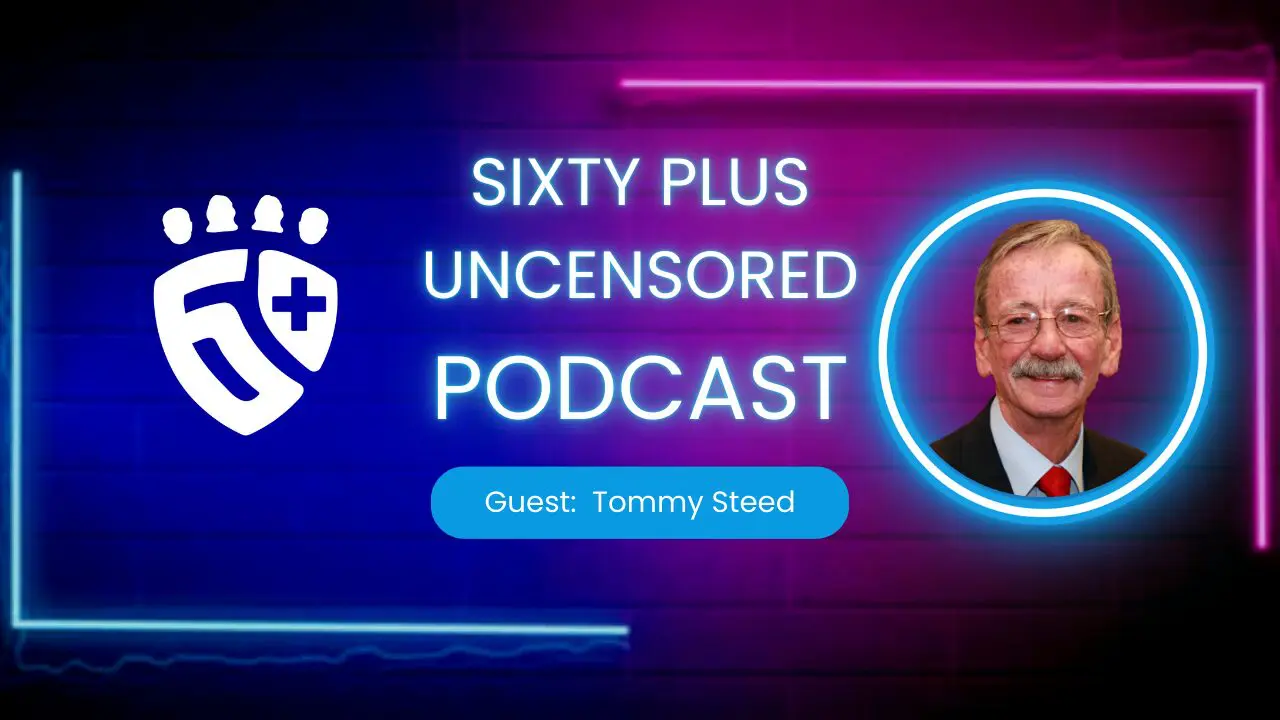
In this episode of 60 Plus Uncensored, host Seb Frey sits down with Tommy Steed, a native New Yorker who grew up in the Bronx within sight of the New York Telephone construction garage. Tommy started his career in 1971 as a cable splicer in Bronx Construction, working the kind of jobs most people never see up close, underground in manholes, overhead on poles, and on urgent recovery efforts that became national priorities. After more than three decades in telecommunications, he retired at 54 but didn’t step away from service. Today, at 76, he’s chairman of the Association of Belltel Retirees—an all-volunteer organization representing about 130,000 former AT&T and Verizon employees. Tommy shares how he found a second calling in advocacy for retirees.
Growing Up in the Bronx With the Work in Plain View
Tommy’s story begins with something that feels almost ordinary, but it matters: he grew up close to the work. He was raised in the Bronx, just a few blocks from the New York Telephone construction garage. Across the street, there was a baseball field where he played Little League, and as a kid, he’d watch the men roll out in their trucks at the start of the day.
Those trucks were green, and Tommy remembers that detail because green was the look of AT&T in those days. The color is a small thing, but it carries the feel of that era, when the telephone system was one huge, visible presence, woven into daily life. He wasn’t imagining what the job might be like. He was seeing it, right there in his neighborhood.
So when he joined the company in 1971, it wasn’t stepping into a mystery. It felt like a world he already knew, and in some ways, it was part of home.
To explore how environment and community shape your later-life mindset, you may also want to read How to Stay Positive and Motivated as You Age.
Early Career in Telecommunications: Cable Splicing, Line Work, and Real Risk
Tommy worked as a cable splicer and a linesman in Bronx Construction. It was outside work, and he describes it plainly as hazardous. Sometimes that meant working underground in manholes, and sometimes it meant working aerial overhead, setting poles, and dealing with power.
Both environments had their dangers, but Tommy names them in a way that makes you picture the day-to-day reality. Manholes could involve natural gas because the gas lines are underground, and leaks happen. He knew men who were blown up in manholes, flash fires that could knock you unconscious if you were lucky.
Then there was overhead work. He describes power as especially dangerous, mentioning 13,200 volts and the fact that you don’t even have to touch it for it to hurt you. If the weather is damp and anything is grounded, electricity can arc. It can reach out.
He doesn’t say any of this to dramatize himself. It’s more like a reminder that there are whole categories of work where “just doing your job” includes a baseline level of danger most people never have to consider. If you’re thinking about how work affects health and aging over time, you may also want to read The Science of Staying Sharp: How to Keep Your Brain Young After 60.
On the Front Lines During Major Recovery: The 1975 Telephone Company Fire
One of the most hazardous projects Tommy worked on was the 1975 New York Telephone fire at 2nd Avenue and 13th Street. He says it took over a day for the fire department to get the blaze under control. It became a national priority, and the scale of the response still sounds unbelievable when he describes it.
Tommy says 699 firefighters fought that fire in one building. Many of them suffered what he calls “everlasting effects.” Friends of his who were firefighters told him their medical files were stamped with a red star, a unique mark that they came to see as the “red star of death.” In Tommy’s telling, many developed cancers and died prematurely, late 40s or early 50s, linked to that one job.
He connects this to a broader truth about emergency work. Just as many first responders were affected by the World Trade Center attacks, earlier crises left their own long shadows. The headlines fade, but the effects stay in bodies, in families, and in medical files.
The Bell System Breakup: “Ma Bell” Ends and the Industry Changes
Tommy’s career spanned one of the biggest shifts in American telecommunications: The breakup of the Bell System.
He describes how AT&T, on its last day, December 31, 1983, had an enormous workforce, and that on January 1, 1984, divestiture took effect. The old system was split into seven regional Bell operating companies, often called the “Baby Bells.” Tommy’s company became “9X”, which he describes as New York, New England, and the “unknown X factor”.
From his personal point of view, the change looked small at first. He came into work one day, and the sign on his truck door had changed. Where it used to say New York Telephone, it said 9X. Same work, different paint.
But Tommy’s opinion of the breakup is strong: he calls it the worst thing the U.S. government ever done to citizens. His reasoning is about uniformity and stability. When there was one system, everything was consistent from New York to California, equipment, standards, and the way the network worked. He describes the Bell System as complicated but “uniformly simplified,” and he speaks with pride about Bell Labs and the engineers and scientists who were part of that ecosystem.
Whether someone agrees with him or not, it’s clear his view comes from inside the work. He lived under both systems. He saw the transition happen in real time, and he saw complexity grow.
A Long Career, Then a Quiet Exhaustion: When the Body and Mind Start Sending Signals
Tommy worked for over 32 years and retired in his 33rd year. He retired at age 54, and he makes a point of explaining why. It wasn’t only about being ready for retirement on paper. It was about the toll.
He says if you work in an office, maybe you can work until 65. But if you work outside, especially through winters, for over 30 years, it starts to take a toll on your body and on your mental sharpness.
He gives a small example that says a lot: forgetting to put chalk under the rear tire of the truck so it doesn’t roll. That kind of detail matters in a job where a small mistake can become a serious accident. For him, it wasn’t about shame or failure. It was a signal.
That’s when he decided he’d had enough. And in a culture that pushes people to measure their worth only through output, it’s worth saying out loud: knowing when to stop can be wisdom. Sometimes it’s the most responsible choice you can make.
For a deeper dive into recognizing when it’s time for a change, you may also want to read When Retirement Feels Too Small: How to Reclaim Purpose, Connection, and Joy.
Burnout, Boredom, and Feeling “Finished” — Then Realizing You Aren’t
Tommy says something that frames the second half of his story: “I retired at age 54, but I knew I wasn’t finished yet.”
That line matters for anyone thinking about life after 60, because it shows that reinvention after 60 doesn’t always start at 60. Sometimes it begins earlier, in the moment you step away from a role that defined you, and you realize you still want to contribute.
Tommy had spent his working life around crews, systems, risk, and responsibility. The idea of simply stopping wasn’t satisfying. He still had energy, and more importantly, he still cared.
So instead of drifting, he moved toward the thing he already understood: organizing people around a shared purpose.
The Turning Point: Union Organizing and a New Model of Working Together
Tommy was a lifelong member of the Communications Workers of America. During his career, he served as a shop steward and later became a union organizer with Local 1120. The union sent him to school to train him to organize, and that training shaped how he looked at problems and power.
When he saw the structure of the Association of Belltel Retirees, he recognized something he hadn’t been able to build inside the company itself. In a private company, management couldn’t join a union. But in this retiree association, management and craft could work together.
Tommy describes it as “the whole ball of wax from top to bottom.” In his view, you need all parts of the system, people who understand the day-to-day work and people who understand the top-level decisions, working together to protect pensions and benefits and to address the company on multiple fronts.
That collaborative structure became the foundation for his post-retirement purpose.
The Leap Into Advocacy for Retirees
Tommy didn’t treat retirement as a quiet exit. He treated it as a pivot.
Over time, he became a board member in 2012 and was elected chairman almost five years before the conversation (he doesn’t name the exact year in the text). Today, he is chairman of the board of the Association of Belltel Retirees, which he says includes about 130,000 members, former employees of AT&T and Verizon.
He also emphasizes that the organization is all volunteer at the board level. Nobody collects a salary. They are “collective minds” working together when problems arise, and doing it for the people they work alongside.
When Seb asks what keeps him going at 76, when many people might want to simply relax, Tommy answers without hesitation: his conscience. He says he worked with “the greatest people in the world,” he loves them, and he wants to help them.
Emotional Challenges: Identity, Confidence, and the Fear of Losing Sharpness
Tommy is also honest about aging in a way that feels familiar to a lot of people.
He says he’ll do the chairman role as long as he’s healthy enough, especially mentally. He jokes that sometimes he can’t remember what he had for lunch yesterday. It’s light humor, but it also names a real fear: what happens when you start “losing it up here”?
He doesn’t pretend he’s invincible. He doesn’t talk like someone trying to outrun age. Instead, he talks like someone trying to stay steady and useful, while also being realistic about limits.
He also emphasizes that he doesn’t do it alone. He has a team and a board. That matters because staying relevant later in life often isn’t about personal toughness. It’s about staying connected to others, building structures that don’t depend on one person, and sharing responsibility.
The Learning Curve: Degrees, Training, and Taking Education Seriously
Tommy’s reinvention after 60, and really, his reinvention after retirement, wasn’t only about passion. It also involved learning.
He earned a bachelor’s degree in labor studies and a master’s degree in public administration. He describes public administration as work that applies to government, nonprofits, and unions. He also emphasizes something that shaped his path: Verizon paid 100% of his tuition for his degrees. He says he never paid a dollar of tuition himself, though he did buy textbooks.
There’s a grounded lesson here. Learning doesn’t have to be glamorous to matter. It can be practical. It can be aligned with the work you feel called to do. And it can help you build the tools for a second act that isn’t just improvisation.
If you want to learn more about continuing education later in life, you may also want to read How Lifelong Learning Keeps Your Brain Sharp After 60.
Health Challenges: Lead Poisoning and Feeling Disposable
One of the harder parts of Tommy’s story is the way he talks about exposure and how the system handled it.
In 1987, he had high levels of lead poisoning, 43 micrograms, which he says was just below the threshold of 50 that would have required hospitalization. He describes what it felt like: waking up, eating breakfast, and vomiting. He knew something was wrong, but a doctor told him that lead testing wasn’t part of normal blood testing. It was a specific industrial test.
Tommy only found out after his annual company physical. Two weeks later, his boss told him the medical wanted him back for a second blood test. The first test had detected lead poisoning, and by law, they were mandated to send results to the New York State Department of Health in Albany. Tommy says the company didn’t have to tell him “ethically or morally,” and he found out through the state.
He explains why lead exposure was part of the job. Cable splicers worked with lead sleeves and soldered them airtight, because manholes fill with water. Lead sheathing from older cables could become porous and create dust when disturbed. He describes seeing black residue around his mouth and nose after wearing a handkerchief.
And then he says something that lands hard: “We were disposable.” Even though human resources were the company’s best resource, he says, employees were treated as disposable.
He describes the “cure” for his lead poisoning in simple terms: drink a lot of liquids, purify your system, and stop being exposed.
Cancer and the Scare That Changed Everything
In 2008, Tommy developed stage three lymphoma. He describes chemotherapy every three weeks for almost four months, and he doesn’t soften it: it “knocks the hell out of you.”
He explains the rhythm of treatment in practical terms. On the day you get chemo, you feel fine. Then your white blood cells drop. The day after and two days after, he says he’d be at his all-time low, he called it “going into the basement,” often in bed. The three weeks between treatments were there so the body could rebuild enough to survive the next round.
When Seb asks what stage three meant, Tommy answers clearly. If it had been stage four, they would not be having this conversation. He barely made it back from stage three, but he says they got him just in time.
The way he was diagnosed is also part of the story. He had a lump on his neck for over a year. He had seen two medical doctors, and nothing was found. Then he mentioned it to a friend who had recently graduated from Cornell Medical School and was working as a physician’s assistant. That friend got angry and pushed harder, working deep into nights until he figured it out.
Tommy credits that friend with saving his life.
After treatment, his doctor monitored him carefully through PET scans, first every three months, then every six months, then once a year. Five years in, the doctor finally said that if it hadn’t come back in five years, he could confidently say Tommy was cured. Tommy says good doctors are cautious, and he believes that caution matters.
The Practical Stakes: Medical Benefits, Medicare, and Why Advocacy Matters
Tommy repeatedly brings the conversation back to benefits because, for retirees, benefits are not abstract. They’re the difference between stability and panic.
He says his Verizon medical benefits paid for his cancer treatment. He describes receiving a concentrated injection every three months that cost $3,300, and Verizon paid 100% of it.
He also talks about how Medicare works at 65. Medicare becomes primary and covers the first 80%, while corporate benefits become secondary and pick up the remaining 20% through supplemental coverage. He mentions paying a monthly Medicare premium out of Social Security (he cites $185 per month in the conversation).
He also makes a point for younger retirees who take lump-sum buyouts instead of monthly pensions: your medical coverage still matters. You may feel like you took your chips off the table, but medical is still part of what you’re relying on as you age.
In other words, the advocacy work isn’t just about policy. It’s about people’s lives. To better understand the bigger picture of healthcare planning after retirement, you may also want to read Navigating the Health Care System After Retirement: A Complete Guide for Adults.
Pension Risk Transfers and the Fight to Be Heard
Tommy describes one of the biggest issues facing retirees as pension risk transfers. He explains it as shifting a defined pension benefit, one that is federally protected, over to private insurance arrangements. He names this as a growing trend that affects many companies, not just Verizon, and he describes the scale as nearly $500 billion transferred.
He also describes a major legal fight after Verizon transferred 41,000 management pensions in 2012. The case went to court in Texas, then to an appellate court in New Orleans, and eventually reached the United States Supreme Court. Tommy says the Supreme Court receives about 800 petitions a year and hears about 80 cases, and their petition was accepted.
They lost in a 5–4 decision, but Tommy still describes the effort as significant. They took it as far as it could go, and he speaks with pride about holding on tenaciously.
Whether someone understands all the legal mechanics or not, the emotional core is simple: people banding together to fight for protections they were promised, because an individual retiree doesn’t have the resources or expertise to take on a corporation alone.
If you’re considering how to protect your financial foundation in retirement, you may also want to read 7 Common Financial Mistakes Seniors Should Avoid.
The Spaghetti Lesson: Why Community Is a Strategy, Not Just a Comfort
Tommy shares a story from organizing school that becomes one of the clearest lessons in the entire conversation.
A veteran organizer held up a single strand of spaghetti and snapped it easily. Then he held a whole box of spaghetti together in his hands and said he couldn’t break it.
That, Tommy says, is what an association is: people bonding together for the good of each other.
It’s a simple image, and that’s why it works. It’s also a strong argument for staying connected later in life. Not just for the company, but for strength.
For more on building connection and structure after leaving full-time work, you may also want to read Creating a Fulfilling Lifestyle After Retirement.
Life Now: Volunteering, Beekeeping, and Staying Active on Purpose
Tommy talks directly to people his age. He says he’s 76, and he encourages retirees who are asking “what’s next?” to volunteer.
He suggests volunteering in your community, in your church or place of worship, and joining local committees. He gives everyday examples, parade committees, barbecue committees, anything where people are needed to make the community work. He frames time as a luxury that retirees finally have, and he calls volunteering a worthwhile endeavor for the good of the community.
He also describes his beekeeping, which gives his retirement life a vivid, surprising texture. He has an apiary with 25 hives, and in July, he says he can have up to about a million and a half bees. In winter, the queen stops laying eggs as the days shorten and the cold comes.
He tells a story about a woman in Southern California who found her car covered in a swarm of bees. Driving on the freeway didn’t shake them off, because the queen was in the trunk. Once the queen flew out, the swarm followed.
Tommy calls beekeeping “a bit of an eccentric hobby,” and jokes that people get a little eccentric after 60. But he also points out that many retirees become beekeepers, join clubs, attend monthly meetings, and share expertise.
The deeper point is that he doesn’t want people to “sit around and grow old.” He wants people to walk into old age, hopefully trot, maybe even run, while staying active and engaged.
That, in a grounded way, is staying relevant later in life. It’s not about chasing youth. It’s about choosing participation. If you’re looking for practical ways to stay engaged and energized, you may also want to read 10 Best Jobs for Seniors Looking to Stay Active.
Practical Advice for Reinvention After 60
When Seb asks what someone should do after retiring, Tommy’s advice stays simple and repeatable.
He says: Volunteer for public service in your community. Volunteer with your church or place of worship. Look for retiree groups tied to major companies. Pick up a hobby, and if you don’t know where to start, go fishing and take your grandchildren fishing.
He returns again and again to time as the key resource. Retirement gives you a kind of time you never had during working life, and he treats that time as something to use, not something to waste.
Near the end, he says something that sums up his philosophy: “Give until you feel good.” Volunteer, donate, and give until your conscience feels good, because when your conscience feels good, you’re going to be okay.
Conclusion: Curiosity, Contribution, and the Kind of Strength That Lasts
Tommy Steed’s story isn’t a performance of “successful aging.” It’s a life shaped by work, risk, loyalty, and the decision to keep showing up even after the official career ended.
He spent decades doing hard, dangerous jobs that kept the city connected, and he lived through consequences that were real, lead poisoning, stage three lymphoma, and the long uncertainty that followed. And still, he comes back to purpose in a way that feels steady rather than dramatic: help your people, protect what’s right, and stay engaged.
For anyone thinking about life after 60, Tommy’s example makes reinvention after 60 feel less like a grand makeover and more like an honest next step. Purpose can come from advocacy, from volunteering, from joining a group, or from learning something new, like beekeeping. The details will differ, but the pattern is the same: stay connected, stay useful, and don’t let your world shrink.
That’s what aging with purpose looks like in real life. It’s not about proving you still matter, it’s about choosing to participate in ways that fit who you are now.
If you’re wondering what’s next, you don’t need a perfect plan. Start small and stay curious. Try one new thing, show up in one place, or help one person who needs a steady voice. Confidence often follows later, quietly and for real, and that’s one of the best ways of staying relevant later in life.