

Seb Frey is a REALTOR® and founder of Team Sixty Plus, a curated network connecting older adults and their families with trusted professionals across California. With decades of experience helping homeowners 60+ navigate major life transitions—like downsizing, aging in place, or passing on a legacy—Seb brings deep market knowledge, a compassionate approach, and a commitment to simplifying complex decisions. When he’s not advising clients, he’s sharing expert insights on real estate, retirement strategies, and quality-of-life resources for the 60+ community.
My Seasoned Living Strategist guide to safer living, fewer falls, and staying in your home longer (with real-world costs, timelines, and how to hire the right pros) Here are the home modifications for aging in place that I see make the biggest difference for families.
If you’ve lived in your home for a long time, you already know something younger homeowners don’t fully appreciate: a house isn’t just a structure. It’s a system you’ve built your life around. The routines are familiar, the neighborhood feels like yours, and the idea of moving can feel like trading comfort for chaos.
That’s why “aging in place” isn’t a trend in my world—it’s the default preference. Nationally, most older adults want to stay in their homes and communities as long as possible. And there’s a practical reason, too: the safest, most affordable “senior living plan” for many people is simply making the home they already own work better for the years ahead.
The money side of this is not subtle. Falls are common and expensive. CDC materials have long cited roughly $50 billion in annual medical costs tied to older adult falls (non-fatal plus fatal). More recent research has estimated $80 billion in healthcare spending for non-fatal falls in 2020 alone. That’s the “system-level” cost, but the personal cost is what I care about: one bad fall can trigger a cascade—hospital stay, rehab, loss of confidence, and a fast, unwanted move that nobody planned for.
So when I talk about home modifications, I’m not talking about “nice upgrades.” I’m talking about risk management and independence. The right modifications can reduce fall risk, improve daily comfort, and help you stay in control of your timeline.
Tap Into your Home Equity
Need to raise some cash to pay for home improvements, or anything else? Get our Guide on Creative Ways to Tap Into Home Equity
Get our Guide!A note on “popularity” and the ranking below
You asked for the top 10 modifications “in order of popularity, in terms of how many homes per capita get these modifications each year.” Here’s the honest reality: there isn’t a single authoritative U.S. dataset that tracks annual per-capita installation rates for every modification category in a way that allows a precise yearly ranking.
What we do have are strong proxies: national studies and surveys on which features are most commonly present or installed (e.g., entrance railings, grab bars, bath seats), plus industry and research summaries on the most common aging-in-place updates. For example, a U.S. HHS/ASPE report found that common assistive home features included railings at the entrance and grab bars in the shower/tub, among others. We also have reputable consumer and industry sources describing which updates are most common for aging-in-place remodeling (grab bars, curbless showers, raised toilets, etc.).
So the ranking below is my best “real world + evidence-informed” ordering based on: (1) prevalence in national data where available, (2) how frequently these changes show up in aging-in-place checklists and remodeling guidance, and (3) what I consistently see older homeowners actually doing first because it’s affordable, fast, and high-impact. When the industry data and the lived reality align, you can trust the list.
Now let’s get into it.
1) Entrance handrails and step supports (the most common “assistive feature” category)
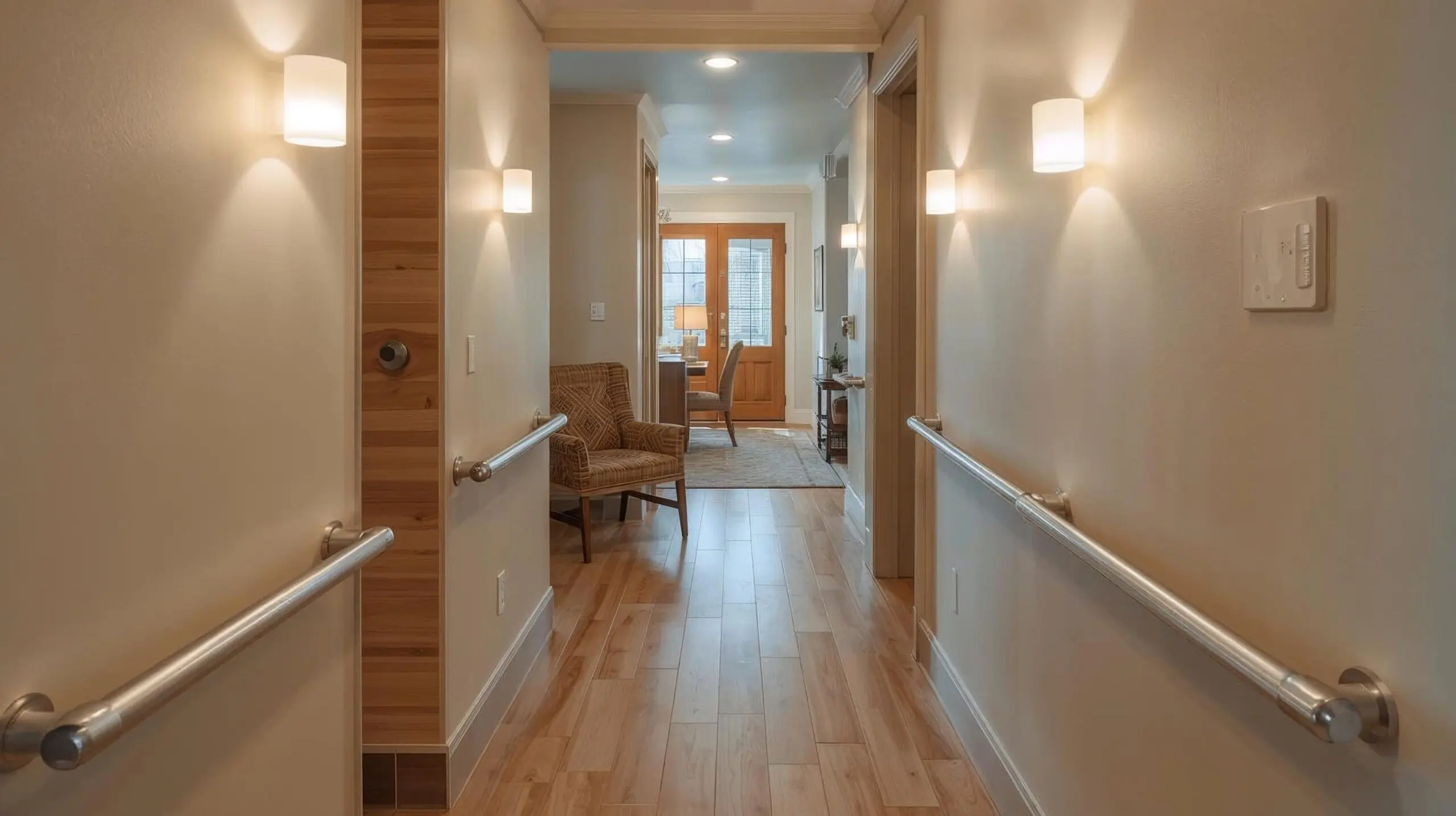
If I’m walking a home with a client and I see exterior steps with no sturdy handrail, my brain immediately goes into “future fall scenario” mode. Entryways are non-negotiable because you use them in all conditions—bright sun, rain, carrying groceries, distracted, tired.
National data has repeatedly shown entrance railings as one of the most common assistive features installed or present. It makes sense: it’s visible, it’s straightforward, and it’s a high-leverage safety improvement.
What it typically includes: replacing a wobbly rail, adding a rail where none exists, extending rail length, improving grip shape, and ensuring it’s anchored correctly.
Time for a typical home: 2–6 hours for a straightforward install; 1–3 days if custom fabrication or tricky anchoring is involved.
Typical cost (2,000 sq ft home):
- Basic rail install: $250–$900
- Custom metal rail (longer runs, curves, powder coat): $1,000–$3,500+
Pro tip: a rail that looks nice but flexes under pressure is just decorative anxiety. You want a rail that feels like it could hold up your future self on your worst day.
Maximizing Your Social Security
Many People Miss Out on $100,000+ In Social Secuirty Benefits! Don’t be one of them. Our Clear and Complete Guide Explains It All
Get the Guide!2) Bathroom grab bars (shower/tub first, then toilet)
Bathrooms are where fall risk and injury severity collide. Smooth surfaces, water, awkward movements, and hard landings. Grab bars are consistently listed among the most common aging-in-place modifications, and national data supports their prevalence.
What it typically includes: grab bars in the shower/tub area, a bar or two near the toilet (especially for sit-to-stand), and sometimes a bar at the bathroom entry if there’s a tight turn.
Time: 1–3 hours for 1–3 bars, assuming standard wall access; longer if blocking needs to be added behind walls.
Typical cost:
- Grab bar hardware: $25–$90 each
- Installation: $150–$350 per bar (Bay Area tends to be higher; tile and wall type matter)
Contractor reality check: I strongly prefer a pro who understands anchoring into studs or proper blocking. Suction grab bars are not a primary safety plan. They’re a “maybe I’ll hold my breath and hope” plan.
3) Improved interior lighting (especially hallways, stairs, and the bed-to-bath route)
If grab bars are the headline, lighting is the underrated MVP. Poor lighting increases falls because people can’t see edges, clutter, or transitions clearly. AARP guidance routinely emphasizes lighting as a step toward aging-friendly homes, and home-safety resources consistently list it as a priority.
What it typically includes: brighter LED bulbs, added fixtures in dim areas, motion-sensor night lighting, illuminated stair landings, and switching layouts that reduce “dark zone” hallways.
Time: from 30 minutes (bulb swaps) to 1–2 days (new fixtures or wiring).
Typical cost:
- Simple upgrades (bulbs, plug-in motion lights): $50–$250
- Adding/relocating fixtures and switches: $300–$2,500+
- Whole-home “lighting tune-up” with electrician: often $800–$4,000 depending on scope
And here’s a stat that matters: in AARP’s home/community preferences research, a large majority of adults 50+ say it’s extremely important to have trustworthy, high-quality contractors available. Lighting is a perfect example—simple when done right, frustrating when done poorly.

Everyone Needs a Little Help Sometimes
There’s so much to know when it comes to lifestyle choices for Older Adults, it’s hard to know even where to begin. One way is to simply click on the button below and let one of our coaches give some guidance – at no cost to you.
Get Help Now4) Non-slip surfaces and safer flooring (bathrooms, entries, and transitions)
You don’t need a full remodel to make floors safer. You need traction in the places that matter: bathrooms, entryways, kitchens, and any slick hallway run.
This category includes non-slip strips in showers, slip-resistant coatings, and flooring replacement when surfaces are truly hazardous. Non-slip floors show up repeatedly in home-modification literature.
Time:
- Non-slip treatments: 1–3 hours
- Flooring replacement (select rooms): 1–4 days
- Whole-home flooring (2,000 sq ft): 4–10 days
Typical cost:
- Shower non-slip strips/mats: $20–$120
- Professional slip-resistant coating: $300–$1,500 (area dependent)
- New flooring installed: $6–$15 per sq ft typical installed ranges (material + labor). For 2,000 sq ft, you’re often looking at $12,000–$30,000+ depending on prep, subfloor, and material choices.
I’m not saying everyone needs new floors. I’m saying: if you have glossy tile that turns into an ice rink the moment it’s damp, let’s not pretend that’s “fine.”
5) Raised/comfort-height toilets and toilet support
This one is quietly popular because it solves a real daily problem: the sit-to-stand motion. When knees, hips, or balance change, toilets become a recurring mini-challenge—multiple times a day.
Raised toilets and toilet supports are frequently mentioned in aging-in-place renovation lists and safety guidance.
Time: 1–3 hours.
Typical cost:
- Comfort-height toilet: $250–$700
- Installation (plumber/handyman): $250–$600
- Optional bidet seat (comfort + hygiene): $300–$1,200 plus outlet if needed
This is one of those changes where people say, “Why didn’t I do this sooner?” (Usually right after their first effortless sit-to-stand.)
Medicare Made Simple
Medicare can be complicated – so let us break it down for you! Get our quick and easy guide, Medicare Made Simple!
Get the Guide!6) Curbless (zero-threshold) shower conversion or safer shower entry
Curbless showers are a classic aging-in-place upgrade because stepping over a tub or shower curb is a common fall moment. Industry and consumer sources regularly cite curbless showers among the most common aging-in-place remodel updates.
Time: typically 1–3 weeks depending on the contractor schedule, demolition, waterproofing, tile, inspections, and finish work.
Typical cost (Bay Area ranges can be higher):
- “Refresh” to improve safety (shower pan, door changes, fixtures): $3,000–$8,000
- Full curbless conversion: $10,000–$25,000+
- Full bathroom remodel with accessibility focus: $25,000–$60,000+
If budget is tight, a middle-ground approach is often smart: change out slippery tub floors, add a secure grab system, add a bench, and improve lighting—then plan a full shower conversion later.
7) One-step solutions: ramps, threshold ramps, or a true “zero-step entry”
“Zero-step entry” sounds fancy, but it’s really about eliminating a risk point. Even one step can become a daily hazard for someone with changing mobility, vision, or balance.
Exterior improvements like ramps and step-free entrances are common in aging-in-place discussions and are frequently recommended for accessibility.
Time:
- Small threshold ramp: 30 minutes to 2 hours
- Modular ramp system: 1 day
- Permanent, custom ramp/entry regrade: 2–10 days
Typical cost:
- Threshold ramp: $50–$300
- Modular ramp: $1,000–$4,000
- Permanent entry redesign: $5,000–$20,000+ depending on grading, hardscape, and permitting
The big mistake here is treating ramps like temporary equipment. A poorly designed ramp can be dangerous. Slope, handrails, landings, and traction matter.
8) Wider doorways and easier passage (especially bathrooms)
Doorway widening isn’t the first thing most homeowners do because it feels “construction-y.” But it becomes more common when mobility devices (walkers, wheelchairs) enter the picture or when tight bathroom entries become frustrating.
Door widening and accessibility improvements are core categories in home modification research and aging-in-place design.
Time: 1–2 days per doorway typically (more if structural issues arise).
Typical cost:
- Basic interior door widening: $800–$2,500 per door
- Bathroom doorway widening with repositioned plumbing/electrical: $2,500–$7,500+
If you want a lower-cost alternative in the short term, swing-clear hinges can sometimes create a little more clear width without rebuilding the opening, but they’re not a universal fix.
You Need a Winning Strategy
When it comes to navigating the ocean of resources for older adults, it helps – a lot – to have someone who can show you the way. Book a call with a coach to save time, money, and no small amount of frustration.
Click Here to Book a Call9) Lever-style handles and easy-grip hardware (doors, faucets, and knobs)
This is the “small change, big daily impact” category. As grip strength, arthritis, or hand mobility changes, round knobs become surprisingly annoying—and sometimes unsafe in wet environments.
Lever handles are commonly recommended in aging-in-place checklists because they’re easy to use and relatively inexpensive compared to structural remodels.
Time: a few hours for a whole-home swap.
Typical cost:
- Door lever sets: $25–$120 each
- Whole-home hardware swap (average 2,000 sq ft home): often $300–$1,500 in materials depending on quality
- Labor: $200–$800 if hired out
Same story with faucets: lever controls and anti-scald valves are worth considering, especially in bathrooms.
10) Stair lifts or alternatives when stairs become the barrier
This is often the later-stage modification, but it’s one of the most life-changing when a two-story home starts to feel like a trap. AARP and other home-safety resources often include chair lifts as an option when stairs become hazardous.
Time: often 3–6 hours for installation after measurement and ordering; total lead time depends on manufacturer availability.
Typical cost:
- Straight stair lift installed: $3,000–$7,000
- Curved stair lift installed: $10,000–$18,000+
- Annual maintenance: varies, often $200–$500 depending on service plan
Not everyone needs a stair lift. Sometimes the better financial move is creating a main-floor living setup (bedroom/bath access) if the home layout allows it. But when you need it, you need it.
The financial case for aging-in-place modifications
If you’re thinking, “This is a lot of money,” you’re not wrong. But the better question is: compared to what?
Falls are expensive, both personally and financially. CDC resources estimate tens of billions annually in fall-related medical costs, and newer analyses show the burden is growing. Even if we ignore the national totals, the household-level impact can be severe: deductibles, copays, rehab, home care, and the “opportunity cost” of losing independence or needing a fast move.
From a pure strategy perspective, I think of aging-in-place upgrades in three buckets:
- Low-cost, high-impact prevention (lighting, grab bars, handrails, non-slip surfaces, decluttering and transitions).
- Lifestyle support upgrades (comfort-height toilets, lever hardware, smart lighting, minor reconfigurations).
- Structural solutions (curbless showers, ramps/zero-step entry, doorway widening, stair lifts).
Most homeowners get the biggest ROI by starting with bucket #1 and #2, and then planning bucket #3 based on health, timeline, and budget—rather than waiting until a crisis forces rushed decisions.
How I recommend finding contractors who can do this work well
This matters as much as the modification itself. Older homeowners don’t just need a contractor. They need a contractor who understands safety, communicates clearly, and respects the household.
Here’s my practical, non-fluffy approach:
Start with specialists when the work is safety-critical. For bathrooms, entries, ramps, and anything load-bearing or waterproofing-related, I strongly prefer pros who have done accessibility work repeatedly. One way to screen is to look for Certified Aging-in-Place Specialist (CAPS) training, or firms that explicitly do accessibility modifications.
Use referral ecosystems that see the aftermath. Ask senior move managers, occupational therapists, home care agencies, senior centers, and elder law attorneys who they trust. Those professionals hear the “after-action reports.” They know who shows up and who disappears.
Get two to three quotes and compare scope, not just price. The cheapest bid is often missing something. Ask for a written scope that states exactly what will be installed, where it will be anchored, and what materials will be used.
Verify licensing and insurance. Especially for plumbing, electrical, bathroom waterproofing, and ramps/rails. You don’t want a safety project creating liability.
Ask for photos of similar jobs. Not just “a bathroom remodel.” Ask for “grab bars installed into tile with proper backing,” or “zero-step entries,” or “handrails installed on exterior steps.”
And remember this: many adults 50+ say having trustworthy, high-quality contractors in their community is extremely important. That’s not a “nice to have.” That’s the whole ballgame.

got
questions?
A realistic “timeline and budget” snapshot for a typical 2,000 sq ft home
If I were prioritizing a typical older home for aging in place, a very common phased plan looks like this:
Phase 1 (weekend to 2 weeks): lighting upgrades, handrails, grab bars, non-slip treatments, doorway hardware, basic transitions. Often $500–$5,000 depending on how much is DIY and how many pros are involved.
Phase 2 (2–8 weeks): comfort-height toilets, improved bathroom functionality, minor carpentry, outdoor lighting, small ramp/threshold solutions. Often $2,000–$12,000.
Phase 3 (1–8+ weeks depending): curbless shower conversion, major flooring replacement, door widening, stair lift. This is where budgets range widely—often $10,000–$60,000+ depending on scope.
The bottom line
Aging in place is not about turning your home into a clinic. It’s about making your home quietly support you so you can live longer, safer, and with less risk of the kind of expensive fall that changes everything overnight.
If you want, tell me four quick things—single story or two, tub or shower, any exterior steps, and flooring type—and I’ll map out a “highest impact first” plan with a realistic cost range for the Bay Area.
